
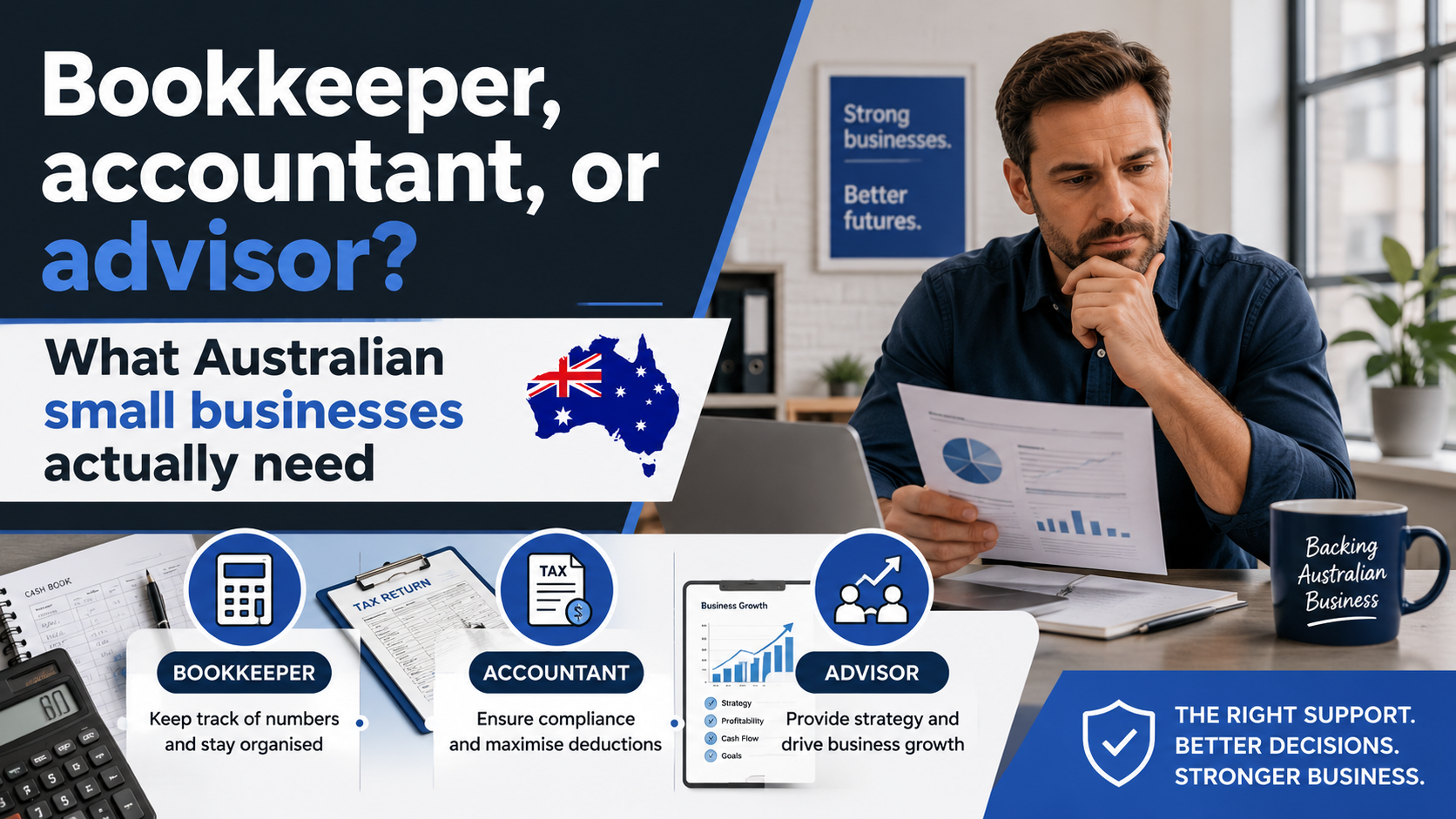
Most business owners ask the same question at some point: do I need a bookkeeper or an accountant? It's a fair question, and the honest answer is usually both. But it's also the wrong question to stop at.
The one that matters more is this: is anyone actually helping me understand my numbers? Because the difference between a business that grows and one that just survives often comes down to whether the owner can see what's really going on financially. Finding a commercially-minded bookkeeper or accountant, someone who reads the numbers as a business story rather than a compliance task, is one of the most underrated moves you can make for growth.
Key takeaways
-
A bookkeeper handles day-to-day records; an accountant handles tax and year-end. Most businesses need both
-
Doing the basics well isn't the same as understanding your numbers
-
A commercially-minded advisor turns your financials into decisions about pricing, hiring, and growth
-
You don't need an expensive full-time CFO to get that clarity
-
Clean, well-structured books are the prerequisite for any of it
What's the difference between a bookkeeper and an accountant?
A bookkeeper looks after the day-to-day. They record your transactions, reconcile your bank accounts, run payroll, manage invoicing, and prepare and lodge your BAS. Their job is to keep your financial records accurate and up to date, week in, week out.
An accountant tends to work at a higher altitude and less often. They prepare your financial statements and tax returns, advise on business structure, and handle year-end compliance with the ATO. You'll usually see them around tax time rather than every month.
The two roles overlap, and plenty of small businesses use both. The bookkeeper keeps the engine running; the accountant signs off the paperwork once a year. For a lot of owners, that arrangement is enough to stay compliant.
Why that question misses the point
Here's the catch. Both of those roles, done the traditional way, mostly look backwards. They record what already happened and report it to the ATO. That's necessary, but it doesn't tell you what to do next.
A bookkeeper who only records the past is leaving your most valuable questions unanswered.
Most owners I speak to can tell me their revenue. Far fewer can tell me their gross margin by product or service, which months their cash actually gets tight, or whether they can afford to take on another staff member without strangling cash flow. That information exists in their accounts. Nobody has organised it in a way that answers the question.
That gap, between data that's merely recorded and data that's actually useful, is where businesses quietly lose money. You can be fully compliant and still be flying blind.
What does affordable financial advisory actually look like?
This is where a commercially-minded bookkeeper or accountant earns their keep. Instead of just filing your numbers, they structure them so you can read them, then sit down with you and explain what they mean.
In practice that looks like regular management reporting, gross margin analysis, simple cash flow forecasting, and a straight conversation about the decisions in front of you. The kind of burning questions most owners carry around but can't quite answer:
-
Should you put your prices up?
-
Can you afford that next hire?
-
If you can, how much should you offer them, so the role pays its way while still being competitive enough to attract the right person?
-
Which part of the business actually makes money, and which part just looks busy?
The good news is you don't need a full-time chief financial officer to get this. A full-time CFO is well out of reach for most small businesses. But a virtual CFO or advisory service gives you the same kind of insight on a fixed monthly fee, scaled to a business your size.
You can't grow a number you can't see.
What changed when one owner cleaned up his numbers
A while ago we worked with the owner of a small commercial cleaning business. (The details here are illustrative, but the situation is a real one.) The work was steady and the jobs kept coming, so on the surface things looked healthy. Yet when I asked about his gross margin, he couldn't tell me. He genuinely didn't know whether most of his jobs were making money.
The problem was labour. In a cleaning business, wages are the biggest cost by far, and his was a tangle. Casual wages, a couple of subcontractors, superannuation, and the time staff spent travelling between sites were all lumped together in one bucket, with no link back to the jobs that generated them. So the single most important number, the true cost of delivering each job, was invisible.
That confusion flowed straight into his pricing. He was quoting on gut feel and on whatever competitors seemed to charge, with no real idea whether a given rate covered the actual cost of the work.
The first job wasn't advice. It was structure. We brought the books up to date and reorganised the accounts so labour was captured properly as a direct cost of each job, including the parts owners routinely forget: superannuation, on-costs, and the non-billable hours spent driving between sites.
Clean books aren't the goal. They're the starting line.
Once that was done, the real picture appeared, and it was sobering. His true gross margin sat well below what he'd assumed. A handful of one-off jobs, especially those across town, were barely breaking even once travel time and on-costs were counted. His regular contract work, on the other hand, was quietly carrying the business.
From there the decisions got easier. He rebuilt his pricing so every quote started from the full cost of labour, not just the base wage. He lifted the rates on the jobs that had been underpriced, leaned into the recurring contracts that actually paid, and let go of the work that never would. He could also finally see when his cash flow would support a new hire, and how much he could offer that person while keeping the role profitable. Same business, same owner. He could just finally see it. That kind of clarity is the whole point of working with a firm like Hopkan Partners.
The bottom line
Yes, you probably need both a bookkeeper and an accountant. But don't stop at "who keeps my records and who does my tax." Ask who's helping you understand what those records mean.
When you're choosing, look for someone who talks about your business, not just your compliance. Someone who can explain your margin, flag a cash flow problem before it hits, and give you a straight answer on whether you can afford to grow. That person is worth far more than their fee.
-
Written by Ben Feng - Founder & Director, Hopkan Partners
Ben Feng is the Founder and Director of Hopkan Partners, a Sydney-based bookkeeping and business advisory firm serving small businesses across Australia.
Before starting Hopkan Partners, Ben spent years in financial and management accounting roles within ASX-listed companies and multinational corporations. This corporate finance background shaped his approach to small business advisory — applying the same rigorous financial analysis used by large companies to help smaller businesses understand their numbers and make better decisions.
Ben founded Hopkan Partners with a clear purpose: to provide small business owners with more than just bookkeeping. Too often, business owners receive financial reports but don’t know what to do with them. Ben’s approach combines accurate bookkeeping with regular financial analysis meetings, helping clients identify opportunities to improve profitability, manage cash flow, and grow sustainably. His clients value the clarity and confidence that comes from truly understanding their business financials.
Ben is a CPA, and is passionate about making financial management accessible and actionable for business owners who want to take control of their numbers.