
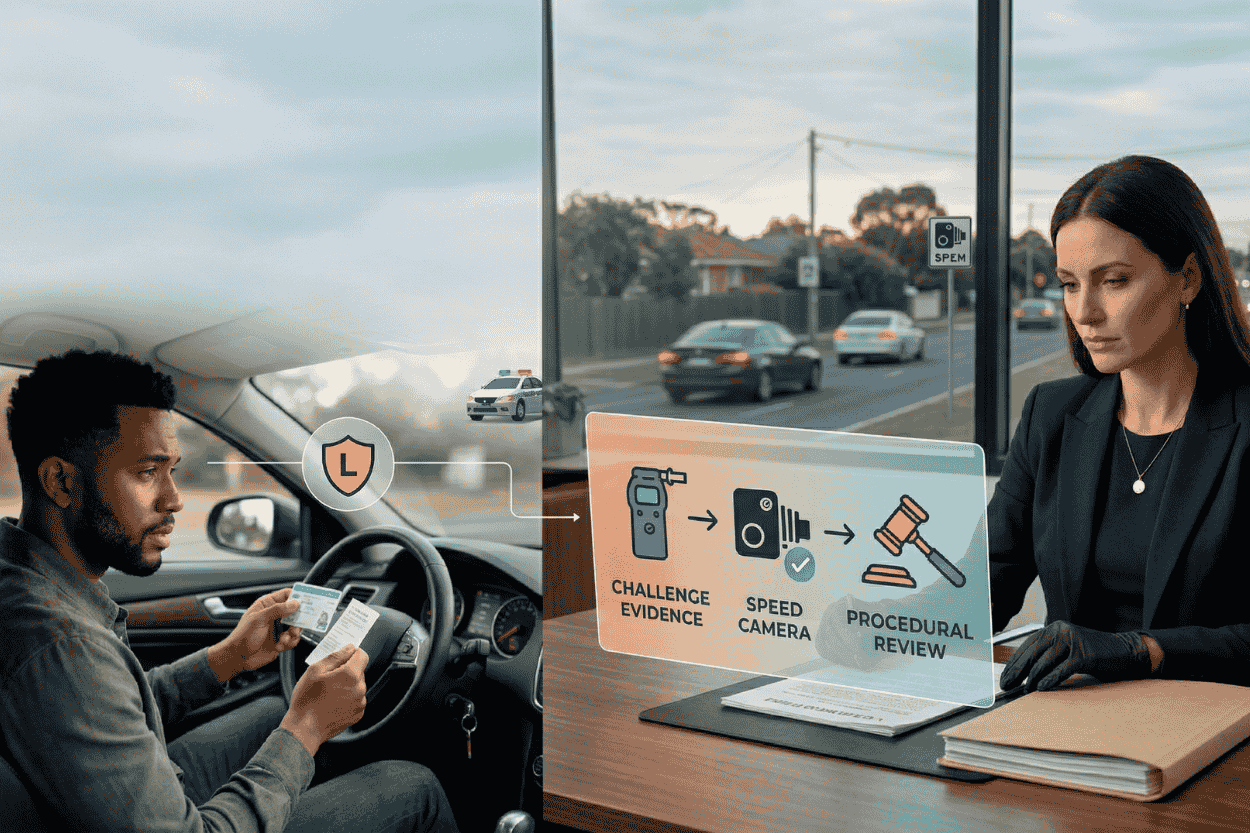
Traffic offences in Victoria may also have severe repercussions, including fines and demerit points, or even the loss of a licence and jail term. Regardless of whether the charge is speeding, drink driving, or dangerous driving, the punishment has the potential of influencing the livelihood, independence, and daily routine of an individual. Most of the drivers are unaware of just how much space there is in order to contest these charges or minimise their effects.
By hiring an experienced driving offence lawyer at the initial stages of the case, it is possible to achieve a completely different result. The lawyer can determine the strength of evidence and the possible defences, as well as represent the driver in the Magistrates' Court of Victoria. This is a closer examination of the major strategies to be utilised in cases of traffic offences.
Challenging the Accuracy of Evidence
The prosecution is one of the first things that a lawyer will examine. In most cases, traffic issues involve the speed camera readings, breathalyser, or even police observation. Attorneys examine the issue of the equipment being in good calibration and maintenance as per the standards. In case a speed camera or a breath analysis device did not undergo its regular service, then the accuracy of the reading can be questioned.
Lawyers also check the issue of whether the police acted according to the proper procedures of the incident. The evidence collected can be disputed in court in case appropriate procedures were not followed during a roadside breath test or a vehicle interception.
Arguing Special Circumstances
The Victorian courts understand that there are circumstances where offences have happened under extraordinary personal circumstances. A lawyer can provide evidence that the driver was experiencing a mental disorder, drug addiction, or that they faced an emergency at the moment of the crime. In case these conditions are proved, the court can take into account the diversion programmes or can give a lighter sentence.
This is especially applicable in the case of first-time offenders or those who can prove that the offending behaviour was not a habit and is unlikely to occur again.
Raising Recognised Legal Defences
There are a number of developed legal defences that are used in traffic offences in Victoria. These include:
- Honest and reasonable mistake of fact: The driver did believe, and reasonably, that he or she was operating within the law, e.g., he or she believed that his or her licence remained valid when it had been suspended without his/her knowledge.
- Necessity or emergency: The driver was committing the offence to address a real medical emergency or life-endangering situation in which no sensible alternative did exist.
- False identification: The prosecution is unable to demonstrate beyond a reasonable doubt that the accused was the driver of the car during the commission of the crime.
A lawyer evaluates the defence to be used in the particulars of the case and collects the evidence to support the defence.
Negotiating Charges and Penalties
Easy cases are usually settled by experienced lawyers without going to a contested hearing with the prosecutors. This may include plea bargaining, whereby a charge is lowered to a minor offence, like the reduction of dangerous driving to careless driving. A lower charge will normally be less serious, and it can assist the driver to evade an automatic disqualification of the licence.
In others, lawyers may negotiate on behalf of both sides to offer a sentencing result that is agreed upon by the magistrate, resulting in more foreseeable and desirable outcomes.
Presenting Character and Mitigating Evidence
The role of a lawyer changes to the minimisation of the penalty when the driver pleads guilty or is found guilty. This is done by providing character references, employment letters, and community participation evidence. The prospect of losing a licence or accumulating demerit points can have devastating effects on the employment and family lives of an individual, and this is the situation that lawyers put before the court to seek fair justice.
Other indicators of rehabilitation measures, like attending a traffic offender programme or undergoing professional counselling, can also be very strong indicators of a request for leniency.
Licence Appeals and Fine Reviews
In addition to court representation, lawyers can help drivers in appeals of suspension of their licence and internal review under Fines Victoria. In case of a wrong issuance of a fine or a legitimate excuse of the driver to act in time, the issue may be reviewed, so that the case is reconsidered.
Conclusion
Legal attention should be given to the traffic offence charges in Victoria. By doubting the accuracy of evidence and increasing legal defences to bargaining and presenting mitigating factors, lawyers are instrumental in defending the rights of a driver and ensuring that the impact of a charge is minimised.