
.jpg)
Digital volatility has become the only constant. The traditional paradigms of business expansion, particularly around how companies build and scale their tech capabilities, are being fundamentally rewritten. This is especially true in custom mobile app development, where speed and adaptability now outweigh traditional planning cycles.
The convergence of AI advancement, persistent global talent shortages, and the rise of strategic offshore partnerships is reshaping mobile app development in ways that would have seemed improbable just five years ago.
The outcome for businesses that navigate this terrain wisely could be substantial gains. For those who misjudge the landscape, well, the costs might be considerable. Most businesses know they need to go digital. But finding the right talent to actually build those digital products? That's where things get complicated, dicey even.
Whether looking to hire software developers locally or outsource IT services to offshore teams, the challenge remains stubbornly consistent: finding people who actually deliver on their promises.
At the forefront of this transformation is Upscalix, a Melbourne-headquartered offshore software development company and IT outsourcing company that bridges what might be called the capability-cost gap.
What distinguishes one offshore outsourcing company from another in this crowded field? The differentiators matter considerably. The company operates with English-proficient software developers working in the Australian timezone, world-class talent with a churn rate of less than 2%, and flexible engagement models spanning dedicated teams to project-based solutions.
What The Data Actually Shows
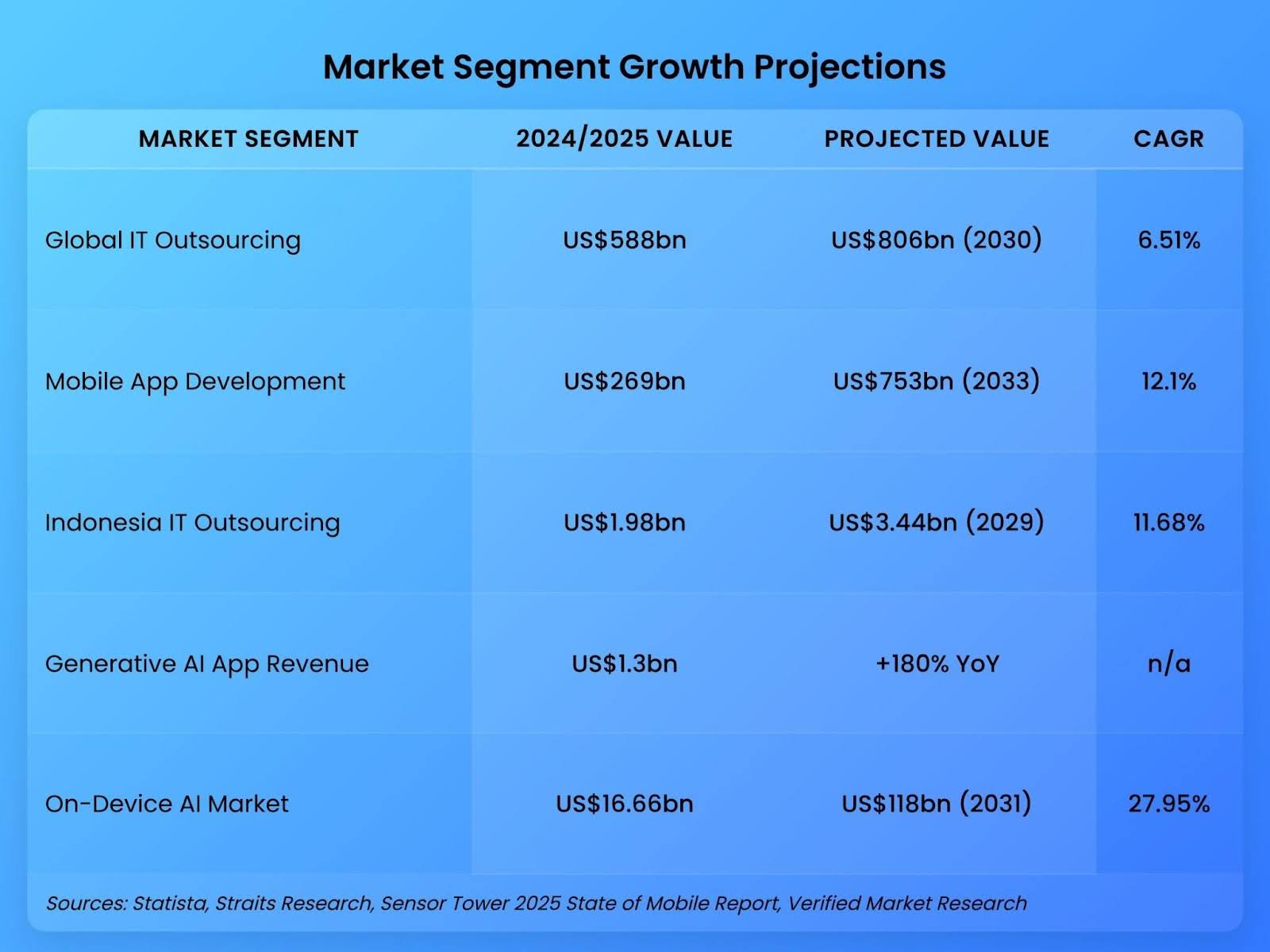
According to Statista, worldwide IT outsourcing revenue is projected to reach US$588 billion in 2025, growing at 6.51% CAGR to US$806 billion by 2030.
Meanwhile, Straits Research values the mobile app development market at US$269 billion in 2024, projecting growth to US$753 billion by 2033. That's a 12.1% CAGR, fuelled largely by smartphone penetration and AI integration demands.
Indonesia has emerged as Southeast Asia's fastest-growing destination for offshore software development and BPO (business process outsourcing).
Statista reports the Indonesian IT outsourcing market reached US$1.98 billion in 2024, with projections indicating growth to US$3.44 billion by 2029. Government initiatives, including "Making Indonesia 4.0", have created favourable conditions, whilst major technology companies like Google, AWS, and Microsoft have established cloud infrastructure regions in the country.
The talent pool is there. The infrastructure is improving rapidly. And the timezone alignment with Australia? That's actually a game-changer for real-time collaboration when businesses need to outsource IT services without the communication headaches.
Why Finding Good Developers Has Become Nearly Impossible
Here's something the industry sometimes tiptoes around. Finding good developers is hard. Finding great developers at reasonable rates? That's approaching a loosey-goosey impossibility in many markets.
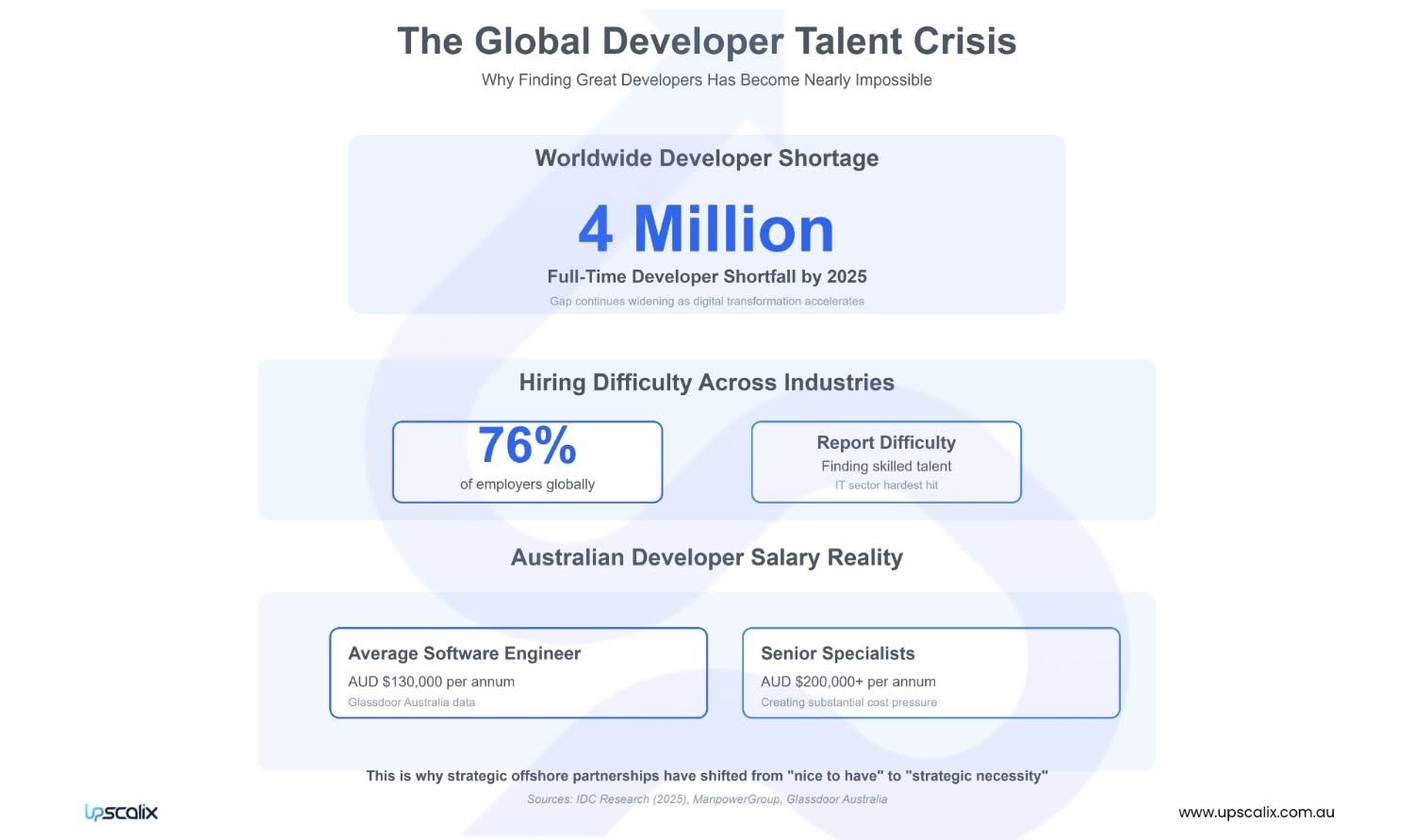
ManpowerGroup research indicates that 76% of employers worldwide face difficulties finding skilled talent, with the IT sector among the hardest hit.
IDC research projected the worldwide shortage of full-time software developers to reach 4 million by 2025, a gap that continues to widen as digital transformation accelerates.
This includes critical shortages in specialised roles like AI developer positions and full-stack software development experts.
In Australia specifically, average software engineer salaries have reached approximately AUD 130,000 annually, according to Glassdoor, with senior specialists commanding upwards of AUD 200,000. For startups and mid-sized businesses, those numbers create substantial cost pressure.
Aha, this is precisely why companies increasingly look to hire software developer teams through offshore developer partnerships. The approach has shifted from "nice to have" to "strategic necessity" for organisations looking to scale without the budget imploding.
How Mobile App Development Actually Redefines User Experiences
So the title makes a bold claim. How does mobile app development actually redefine user experiences? The answer is less about flashy interfaces and more about what happens beneath the surface.
Upscalix's offshore developer teams embed on-device AI and generative capabilities directly into mobile applications. Rather than building static apps that simply respond to taps and swipes, the approach produces adaptive ecosystems that learn from user behaviour.
Think predictive search that understands context before the user finishes typing, interfaces that reorganise based on usage patterns, and notifications timed to precisely when they're actually useful.
The practical results speak clearly. Client implementations of these AI-enhanced mobile solutions have produced booking increases exceeding 70%.
Verified Market Research projects the on-device AI sector to grow from US$16.66 billion to US$118 billion by 2031, at 27.95% CAGR. Apps processing data locally deliver faster response times, better privacy protection, and functionality that works without reliable internet connectivity.
Beyond Cost Arbitrage: What Strategic Partnership Actually Looks Like
One might assume that offshore development is merely about cost arbitrage. That assumption would be incomplete at best.
Upscalix's vision is to improve lives and organisations by releasing the power of innovative digital solutions that increase effectiveness, future growth, and profitability.
The custom software development process emphasises customisable service tailored to specific business requirements, transparent processes at every stage, and flexible engagement based on client needs.
Speed matters here, possibly more than anything else. Upscalix assembles dedicated offshore developer teams within 24 to 48 hours, compared to the 6 to 12 months typically required for in-house recruitment in Australia. That difference isn't marginal.
Cost optimisation with transparency sits at the core of operations. Whilst the 70% savings figure grabs attention, what arguably matters more is the predictable pricing structure and clear scope documentation that prevents budget creep. Every project stage is documented, reviewed, and approved before proceeding.
What sets this apart from the typical outsourcing provider model is end-to-end ownership. Upscalix handles strategy, development, testing, deployment, and ongoing optimisation under unified accountability rather than coordinating between fragmented vendors.
Scalability deserves particular mention. The ability to expand from a two-person team to twenty developers in weeks gives businesses genuine operational agility. The team composition adapts to the work, not the other way around.
"Our offshore developer teams in Indonesia embed on-device AI into custom software development, synchronised to Australian business hours," explains Roderich Hartono, Managing Director of Upscalix. "The result is up to 70% cost savings with measurable outcomes, including client booking increases exceeding 70%."
What Businesses Are Actually Looking For
When Australian enterprises evaluate an offshore outsourcing company or IT outsourcing partner, the conversation has moved well beyond hourly rates.
Specialised technical expertise ranks high on every shortlist. Companies need immediate access to AI developer talent, mobile app specialists, and custom software engineers capable of complex integrations.
The six-month local recruitment cycle simply doesn't work when market windows are measured in weeks.
Cultural compatibility matters more than most vendor selection guides acknowledge. Upscalix's Melbourne-based management layer bridges this gap, ensuring Indonesian development teams operate within Australian professional standards rather than requiring clients to adapt.
Timezone alignment continues to be the practical differentiator. Indonesia operates just 2 to 3 hours ahead of AEST, enabling genuine real-time collaboration. Standup calls happen during normal business hours, not at midnight. Code reviews get addressed the same day. That difference compounds across every sprint.
Upscalix
———————-
Level 11/580 Collins St, Melbourne VIC 3000, Australia
https://maps.app.goo.gl/oHFxXb5W26baQ7d47
Website : https://upscalix.com.au/
Youtube : https://www.youtube.com/@upscalix
LinkedIn: https://www.linkedin.com/company/upscalix/
FAQ
1. How does Upscalix mobile app development redefine modern user experiences?
Upscalix delivers custom mobile app development through Indonesia's top talent working in the Australian timezone, integrating on-device AI and generative capabilities. This approach cuts costs by up to 70% while producing measurable outcomes like client booking increases exceeding 70%.
2. Why has finding qualified software developers become so difficult for Australian businesses?
The worldwide shortage of full-time software developers reached 4 million by 2025, while 76% of employers globally struggle to find skilled talent. Australian software engineers command salaries averaging AUD 130,000, with senior specialists exceeding AUD 200,000, pushing businesses toward offshore partnerships.
3. How quickly can Upscalix assemble a dedicated development team?
Upscalix assembles dedicated offshore developer teams within 24 to 48 hours, compared to the 6 to 12 months typically required for in-house recruitment in Australia. Teams can scale from two to twenty developers in weeks, adapting to project requirements as they evolve.