
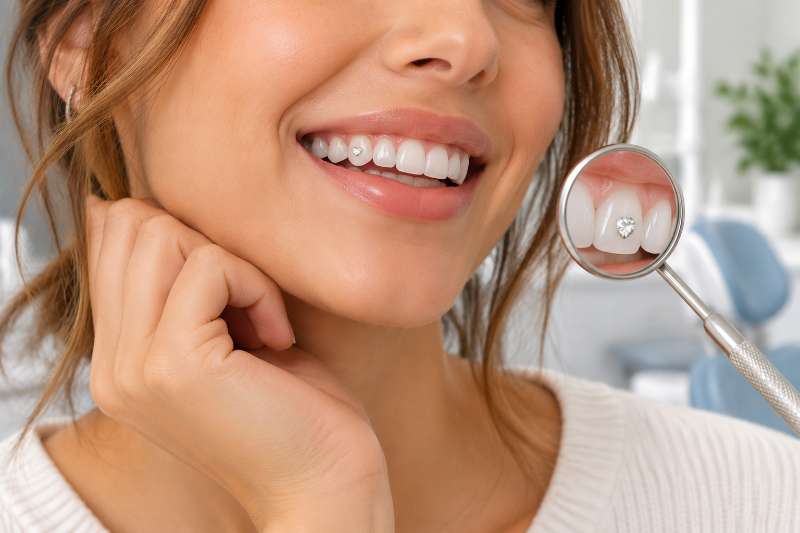
You have probably seen them all over TikTok, and now you are wondering whether that little sparkle is going to wreck your teeth. It is a fair thing to worry about. Tooth gems are not automatically damaging. What matters is how they are bonded, what they are bonded with, and whether you can still clean around them afterwards. The gap between a properly applied gem and a kit bought online is genuinely large, so here is what happens to your tooth in each case.
Key Insights
- A tooth gem is a small crystal bonded to the outside of the enamel with dental adhesive, and correct application does not involve drilling the tooth.
- Most damage linked to tooth gems comes from a tiny gap at the edge of the gem where plaque collects and cannot be brushed away.
- DIY home kits typically use non dental adhesives and underpowered curing lights, producing weak bonds that fail early and trap bacteria.
- A gem that falls off unexpectedly is a choking and aspiration risk, which is the main reason dentists advise against home application.
What Are Tooth Gems, Exactly?
A tooth gem is a small crystal or piece of jewellery bonded to the front surface of a tooth using dental adhesive. When applied properly, nothing is drilled and no part of the tooth is removed.
The trend has grown steadily. Pinterest reported an 85 percent rise in tooth gem searches during 2022, the #toothgems hashtag has passed 393 million views on TikTok, and The Guardian covered tooth jewellery in March 2024.
The process mirrors the one behind fillings and orthodontic brackets. The tooth is cleaned and kept dry, a mild etching gel roughens the enamel so the adhesive can grip, composite resin is applied, the gem is positioned, and a curing light hardens the bond in seconds. Composite resin is the same tooth coloured material used for white fillings.
It should not hurt. Nothing is drilled, and no anaesthetic is normally needed.
Do Tooth Gems Damage Teeth?
Tooth gems do not damage teeth directly, because the crystal sits on top of the enamel rather than inside it. The damage risk comes from the margin, which is the tiny join where the edge of the gem meets the tooth, because plaque collects in that join and a toothbrush cannot reach it.
Enamel is the hard outer layer of your tooth, and it is the only part a gem bonds to. Your body cannot make more of it once it is lost.
Here is the mechanism. Dental plaque is a sticky biofilm of bacteria that reforms constantly. Bacteria including Streptococcus mutans settle in the gap at the gem's edge, feed on sugars, and produce acid. That acid pulls minerals from the enamel underneath, a process called demineralisation. Because you cannot clean the area, it continues quietly. The result can be decay or a chalky white mark exactly where the gem sat, often only found when it comes off.
This mechanism is well established. It is the same reason orthodontic patients develop white marks around brackets when cleaning slips. What is not established is how often it happens with tooth gems specifically, because there is no reliable published rate. Dentists report seeing cases, and reported observation is not the same as measured incidence.
Placement matters too. A gem sitting too close to the gum line can cause inflammation and bleeding. Our gum disease page explains what early gum problems look like.
What Is Actually Wrong With DIY Tooth Gem Kits?
DIY tooth gem kits are riskier than dental application because they fail on three things at once, the adhesive, the curing light and moisture control. Each failure widens the gap at the edge of the gem, which is exactly where decay starts.
|
Applied at a dental clinic |
DIY home kit |
|
|
Adhesive |
Dental grade bonding resin, regulated for use in the mouth |
Generic resin, or nail glue and superglue in many online tutorials |
|
Curing |
Professional curing light, resin fully hardened |
Small LED lights often underpowered, leaving resin soft and porous |
|
Moisture control |
Tooth isolated and kept completely dry |
Near impossible alone, and saliva weakens the bond from the start |
|
Sterilisation |
Cross infection control standards apply |
Shared or reused applicators, no sterilisation |
|
Removal |
Bond released and enamel polished and checked |
Often picked or scraped off, risking enamel loss |
Under cured resin is the one nobody thinks about. It looks fine. It is softer and more porous than properly hardened resin, so it holds plaque and breaks down sooner. You cannot tell by looking.
Weak bonds rarely fall off cleanly either. They lift at one edge first, widening the gap.
A gem that detaches unexpectedly is a choking and aspiration risk, which is the main reason dentists advise against unsupervised home application. Documented cases are rare, but the consequence is serious enough to take seriously.
To be fair, plenty of trained non dentist technicians apply gems carefully with proper materials. The concern here is specifically home application, where none of the safeguards above exist.
How Much Do Tooth Gems Cost?
Professional application in Australia commonly ranges from around $50 to $150 per gem, though prices vary between practices and are worth confirming directly. Online DIY kits sell for roughly $10 to $30.
That gap looks compelling until you compare what you are buying. The higher fee covers regulated adhesive, proper isolation and curing, placement away from the gum line and your bite, and someone who can remove it later without damaging enamel. Treating decay under a gem, or repairing scraped enamel, costs considerably more than the original application either way.
Can Tooth Gems Be Removed Safely?
Yes. Removal by a dentist is usually straightforward, involving releasing the bond, polishing off any remaining resin, and checking the enamel underneath.
The risk sits in doing it yourself. Scraping at a bonded gem with something metal can take enamel with it, and enamel does not grow back. If a gem is loose, that is a short appointment rather than a job for a fingernail.
One point catches people out. Gems generally cannot be bonded to veneers or crowns, because porcelain is too smooth for the adhesive to grip as it does on natural enamel. If you have had cosmetic work done, discuss it first. Our cosmetic dentistry page covers what we do and do not recommend.
Frequently Asked Questions
Q: Are tooth gems safe? A: Tooth gems can be reasonably safe when applied with dental grade adhesive and proper technique, because nothing is drilled and the crystal sits on the enamel surface. Risk rises substantially with DIY kits, where weak bonding leaves a gap at the gem's edge that traps bacteria and cannot be cleaned by brushing. Placement matters too, since a gem against the gum line can cause inflammation.
Q: Do tooth gems damage teeth permanently? A: Not usually, if applied and removed properly. Permanent damage generally comes from two situations, decay developing under a poorly bonded gem, or enamel scraped away during an attempted home removal. Enamel cannot regrow, so removal is the step most worth having done professionally.
Q: How much do tooth gems cost in Australia? A: Application at a dental clinic commonly ranges from about $50 to $150 per gem depending on the crystal and the practice. DIY kits sold online cost roughly $10 to $30, though treating decay or repairing enamel afterwards exceeds that saving many times over.
Q: Can you get tooth gems with braces? A: Usually not on a tooth with a bracket attached, since there is no room to bond the gem and cleaning is already harder with orthodontic appliances. Most orthodontists would suggest waiting until treatment finishes. Ask whoever is managing your braces before booking anything.
The Bottom Line
Tooth gems are not the disaster some people online claim, and not the harmless accessory the kit listings suggest. The truth depends almost entirely on how the gem is bonded and whether you can keep the area clean. As the Australian Dental Association advises for cosmetic procedures generally, anything bonded to a tooth deserves professional assessment.
If you already have one and something feels off, a rough edge, a loose gem, or tender gums, please do not wait it out. Early problems are small and simple to fix. The ones we find late rarely are. You can read more of our guides on our dental blog, or book a check up with our team in Parramatta and we will take a proper look.
Written by My Smile Doctors, Parramatta Dental Clinic. This article is general information only and is not personal dental advice. Everyone's teeth are different, so please speak with a registered dental practitioner about your own circumstances.