
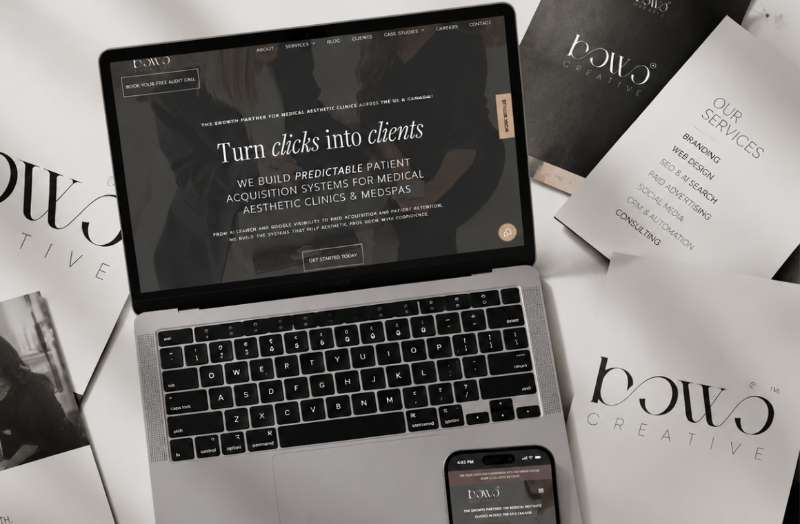
Beauty business marketing in 2026 comes down to three things: being findable in AI-powered search, proving your results with real client evidence, and removing friction between interest and a booked appointment. The tactics that carried salons and clinics through 2024 posting daily, chasing follower counts, discounting to fill gaps no longer move the needle on their own. Below, our team at BOWO Creative shares the twelve strategies we see working right now for beauty businesses in Toronto and across Canada, plus how to prioritise them when your time and budget are limited.
TL;DR: The biggest shift in beauty business marketing for 2026 is where clients start their search. Many now ask AI tools for recommendations before they ever open Instagram or Google. Win by making your website and listings easy for AI to read, collecting reviews and real client results consistently, publishing short-form video from your actual team, and building a booking page that converts. Do fewer things properly rather than everything badly.
Table of Contents
• What is beauty business marketing in 2026?
• What has changed in beauty marketing since 2025?
• What are the 12 best beauty business marketing strategies for 2026?
• How do you promote your beauty business on a small budget?
• What beauty industry marketing tips work best for local salons and clinics?
• How do you measure if your beauty marketing is working?
• Ready to build your 2026 marketing plan?
• Frequently asked questions
What is beauty business marketing in 2026?
Beauty business marketing is the full system that turns a stranger into a booked, returning client your search visibility, website, social presence, reviews, email, and paid advertising working together. What separates 2026 from previous years is that discovery no longer happens in one place. A potential client might first encounter your salon through an AI-generated answer, then check your Google reviews, then watch a Reel, then finally visit your website. Marketing that only performs well in one of those moments quietly loses the client somewhere in the middle.
What has changed in beauty marketing since 2025?
Two changes matter most. The first is AI search. BrightLocal's research found that 45% of consumers were using AI tools for local business recommendations in 2026, up from 6% the previous year an enormous shift in a single year. The second is consolidation of visibility. Analysis of the aesthetics category found that the top 25 brands control roughly 95% of AI citation share, leaving the remaining thousands of facilities to split what is left. That sounds discouraging, but it is actually the opportunity: most local beauty businesses have done nothing to make themselves readable by AI, so the barrier to entry is still low.
The practical takeaway is that clarity beats volume. AI tools cite sources that clearly state who you are, what you offer, where you are, and why you are credible.
What are the 12 best beauty business marketing strategies for 2026?
These are the strategies we prioritise for beauty and aesthetic clients, in rough order of impact:
• Make your site AI-readable: Write plain, direct answers to real client questions. Add clear service, location, and pricing-range information so answer engines can quote you.
• Complete and maintain your Google Business Profile: Fill every field, add photos monthly, and post updates. It remains the strongest local ranking asset you own.
• Build review velocity, not just review count: A steady stream of recent reviews signals an active business. Ask at checkout, every time.
• Publish real client results with consent: Documented before-and-afters convert better than any ad copy see our guide on using user-generated content to fill your booking page.
• Put your team on camera: Short-form video from your actual practitioners outperforms polished stock content, because clients are choosing a person as much as a service.
• Fix your booking flow: Count the taps between landing on your site and confirming an appointment. Every extra step costs bookings.
• Create treatment-specific pages: One page per service, written for both search engines and the nervous first-timer reading it.
• Run retargeting, not just cold ads: People who already visited your site are far cheaper to convert than strangers.
• Email your past clients monthly: Rebooking an existing client costs a fraction of acquiring a new one.
• Invest in professional brand imagery: Visual quality is judged in under a second our branding photoshoots exist for exactly this reason.
• Answer questions publicly: FAQ-style content earns AI citations and reduces the hesitation that stops people booking.
• Track bookings, not vanity metrics: Follower growth is not revenue. Measure what fills your calendar.

How do you promote your beauty business on a small budget?
Start with the assets you already own before spending anything. Your Google Business Profile, your existing client list, and your happy clients cost nothing to activate and typically outperform paid advertising in the first ninety days.
A realistic low-budget sequence looks like this: complete your Google Business Profile fully, set up a simple system to request a review after every appointment, email your past clients once a month with something useful rather than a discount, and post two pieces of short-form video a week featuring your team. Only once that foundation is producing consistent enquiries should you add paid advertising otherwise you are paying to send traffic to a system that does not convert. If you want a hand auditing that foundation, our social media management work usually begins there.
What beauty industry marketing tips work best for local salons and clinics?
Local beauty businesses win on specificity. Rather than competing for broad terms like "beauty salon," build visibility around exactly what you do and exactly where you do it the treatment, the neighbourhood, and the client you serve best.
Three tips consistently outperform for local operators. Name your neighbourhood naturally throughout your website, not just your city. Feature your practitioners by name, with their credentials, because local clients book people rather than premises. And keep your business name, address, and phone number identical everywhere they appear online, since inconsistency confuses both Google and AI tools. For clinic owners specifically, our Toronto medspa growth strategies guide goes deeper on the local side.

How do you measure if your beauty marketing is working?
Track the metrics that connect to revenue. The four worth watching monthly are new bookings by source, cost per booked appointment, rebooking rate, and review volume. Everything else is context.
Give each strategy a fair window before judging it. Paid advertising shows signal within two to four weeks. Search and content work typically take three to six months to compound. Reviews and referrals build slowly, then accelerate. Changing tactics every fortnight is the most common reason beauty marketing underperforms not the tactics themselves.
Ready to build your 2026 marketing plan?
The beauty businesses that grow this year will not be the ones posting most often. They will be the ones that are easy to find, quick to trust, and simple to book. Pick two strategies from this list, run them properly for a full quarter, then add a third. If you would rather have a clear plan built for your specific clinic or salon or call 416 990 0126 we'll map out exactly where your bookings are leaking and what to fix first, before the autumn booking season begins.
Book your free marketing audit with BOWO Creative
Frequently asked questions
How much should a beauty business spend on marketing in 2026?
Most established salons and clinics invest somewhere between 5% and 10% of revenue, with newer businesses at the higher end while building awareness. Rather than fixing a number first, work backwards from your cost per booked appointment and how many appointments you need to fill.
Is social media still worth it for beauty businesses?
Yes, but as proof rather than reach. Social media is where prospective clients verify that you are credible and active before booking. Consistent short-form video showing real results and real staff does that job far better than daily posting for its own sake.
How long does beauty business marketing take to work?
Paid advertising can produce enquiries within weeks. Search visibility, reviews, and content usually take three to six months to build momentum, then compound. Most businesses see meaningful change by month four when the work is consistent.
Do I need to market for AI search as a small beauty business?
It is increasingly worth it. Because most local beauty businesses have not optimised for AI tools yet, clear service pages, complete listings, and genuine FAQ content can earn citations relatively easily and that window will narrow as competitors catch up.