
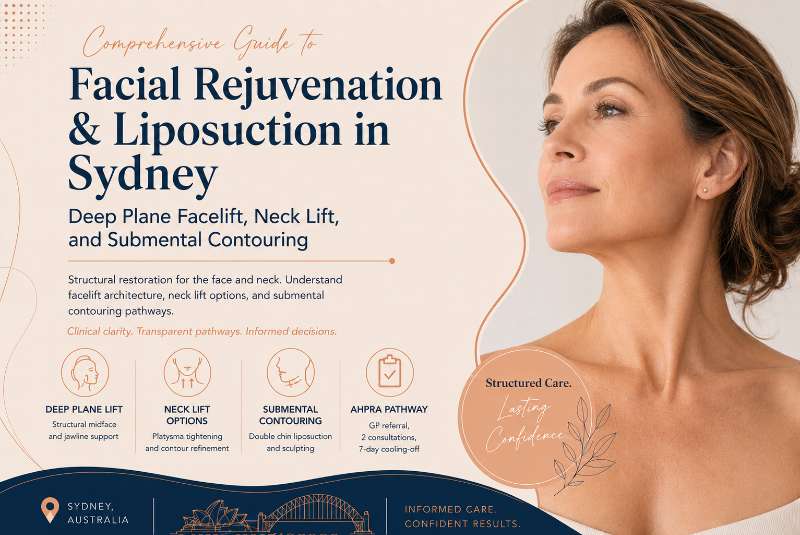
Comprehensive Guide to Facial Rejuvenation & Liposuction in Sydney: Deep Plane Facelift, Neck Lift, and Submental Contouring
AHPRA Mandatory Clinical Notice: Surgical procedures carry inherent medical risks, including bleeding, infection, scarring, and nerve injury. Prior to undergoing invasive surgery, patients must obtain an independent General Practitioner (GP) referral and complete two face-to-face consultations, followed by a mandatory 7-day cooling-off period. Outcomes vary between individuals based on anatomy, skin elasticity, and healing response.
Restoring Structural Balance to the Face and Neck
As the anatomical understanding of facial aging has advanced, modern plastic surgery in Sydney has shifted away from superficial skin tightening toward deep structural restoration. Submental fat accumulation, platysmal band laxity, and midface sagging are multi-layered issues that require tailored surgical interventions.
Whether seeking to redefine the jawline through a deep plane face lift, address vertical neck banding with a neck lift, or reduce localized fat deposits via double chin liposuction, understanding the structural difference between each procedure is essential for informed decision-making.
1. Deep Plane Facelift vs. Traditional Neck Lift
When evaluating options for a face lift in Sydney or a neck lift in Sydney, patients are often comparing two distinct anatomical approaches: superficial skin tensioning versus deep musculoskeletal repositioning.
Facelift Architecture Comparison
Deep Plane Face Lift
A deep plane face lift releases key facial ligaments to release and elevate the underlying Submuscular Aponeurotic System (SMAS) and deep facial fat pads as a single, unified layer.
-
Anatomical Target: Deep facial ligaments, midface malar fat pads, marionette lines, and structural jowls.
-
Key Advantage: Because structural elevation occurs beneath the muscular plane, skin is repositioned without tension, mitigating the risk of a "pulled" or unnatural appearance.
Neck Lift (Platysmaplasty)
A dedicated neck lift focuses specifically on structural laxity beneath the mandible. This procedure frequently involves tightening weakened neck muscles (platysmaplasty) and removing excess skin to re-establish a sharp cervicomental angle (the junction between the chin and neck).
-
Anatomical Target: Separation of platysma muscle bands, submandibular gland prominence, and loose lower-cervical skin.
2. Submental Contouring: Double Chin Surgery & Neck Liposuction
For patients presenting with good skin elasticity but localized fat accumulation under the chin, invasive surgical lifting may not be necessary. In these instances, targeted liposuction in Sydney provides an effective contouring solution.
Double Chin Liposuction (Neck Liposuction)
Also categorized under double chin surgery, submental neck liposuction utilizes micro-cannulas to aspirate excess subcutaneous adipose tissue through tiny, hidden incisions beneath the chin and behind the earlobes.
-
Ideal Candidate: Individuals with localized submental fat deposits who retain strong skin elasticity and minimal muscular laxity.
-
Procedure Mechanics: Cannulas loosen and extract fat cells, allowing the skin envelope to retract over the newly sculpted contour.
Surgical Double Chin Surgery (Submentoplasty)
When submental fullness is caused by a combination of pre-platysmal fat, post-platysmal fat, and loose muscle tissue, a simple liposuction procedure may prove insufficient. In such cases, double chin surgery sydney may involve a small submental incision to directly excise deeper fat pockets and surgically tighten central neck muscles.
Procedural Comparison Matrix
How to Select the Best Plastic Surgeon in Sydney for Your Procedure
Searching for the best plastic surgeon in Sydney requires cutting through commercial marketing to evaluate objective medical credentials and clinical qualifications. Under Australian regulation, patient safety depends on verifying your practitioner's registration status.
Patient Consultation Pathway (AHPRA Framework)
Key Benchmarks for Evaluating a Plastic Surgeon in Sydney:
-
FRACS Accreditation: Ensure your practitioner is a Fellow of the Royal Australasian College of Surgeons (FRACS) in Specialist Plastic Surgery.
-
Protected Title Verification: Confirm the practitioner is registered under AHPRA as a Specialist Plastic Surgeon, not an unaccredited medical practitioner offering general cosmetic services.
-
Hospital Operating Rights: Verify that your procedure will take place in an accredited private hospital with specialist anaesthetists and full intensive care support, rather than an unaccredited day clinic.
-
Transparent Financial Frameworks: Ensure you receive an itemized financial quote breakdown prior to committing to surgery. To understand hospital, surgeon, and anaesthetic fee structures, consult our master guide on plastic surgery costs sydney.
Surgical Risks & Post-Operative Aftercare
All invasive surgeries carry inherent medical risks that must be carefully weighed during your consultation process.
Primary Medical Risks Include:
-
Haematoma and Seroma: Fluid or blood accumulation beneath the skin requiring surgical drainage.
-
Nerve Weakness: Temporary or, rarely, permanent injury to the facial nerve branches controlling motor expression or sensory feeling.
-
Wound Healing Delays & Scarring: Delayed incisional healing, hypertrophic scarring, or skin flap necrosis (drastically elevated by smoking or nicotine exposure).
-
Asymmetry: Subtle structural variations between the left and right sides of the face during dynamic movement.
Please read our Risks and Complications of Plastic Surgery page.
Recovery Protocols
Following a face lift sydney or neck lift sydney procedure, patients are fitted with post-surgical compression garments to minimize localized swelling and stabilize tissues. Heavy lifting, strenuous physical exercise, and bending forward are restricted for a minimum of 4 to 6 weeks to protect surgical integrity and lower internal vascular pressure.
Frequently Asked Questions
Q: Can double chin liposuction be combined with a neck lift or facelift?
A: Yes. In many surgical plans, submental neck liposuction is performed as an initial step to remove excess subcutaneous fat before the underlying platysma muscle is tightened during a neck lift or deep plane face lift. Combining these techniques allows the surgeon to address both volume and muscular laxity simultaneously.
Q: What is the recovery timeframe for a deep plane facelift in Sydney?
A: Initial recovery usually involves 10 to 14 days of downtime to allow visible swelling and bruising to subside. Most patients return to non-strenuous work activities after 2 weeks, while strenuous exercise, heavy lifting, and intense physical exertion must be avoided for at least 4 to 6 weeks.
Q: How do I know if I need double chin surgery or neck liposuction?
A: Skin elasticity is the primary deciding factor. Younger patients with firm skin and localized fat beneath the chin generally achieve satisfactory results with double chin liposuction. Patients with significant skin laxity, visible muscle banding, or sagging tissue usually require formal double chin surgery or a structural neck lift to excise redundant skin and repair underlying muscle layers.
Q: How long do the results of a deep plane facelift or neck lift typically last?
A: Because a deep plane facelift and structural neck lift reposition the underlying deep muscle framework (SMAS layer) and releasing ligaments rather than merely stretching the skin, the structural outcomes are long-lasting. While surgery cannot stop the natural ageing process, patients typically enjoy their rejuvenated contour for 10 to 15 years. This provides significantly greater longevity than temporary non-surgical treatments—such as dermal fillers or thread lifts—which only offer short-term volumetric or subtle tension changes lasting 6 to 18 months.
Q: What is the difference between a "mini facelift" and a deep plane facelift?
A: A mini facelift (often referred to as a short-scar facelift) utilizes smaller incisional patterns around the front of the ear to address early skin laxity and mild jowling in younger candidates. Conversely, a deep plane facelift penetrates beneath the superficial muscular plane to release deep facial ligaments and elevate midface fat pads, jowls, and neck architecture as a single, unified layer. A deep plane approach provides more comprehensive, natural-looking rejuvenation for moderate-to-advanced structural ageing without putting artificial tension on the skin envelope.
Q: Will double chin liposuction leave loose or sagging skin under my chin?
A: The outcome of submental (neck) liposuction depends heavily on individual dermal elasticity. In younger patients with firm, springy skin, removing localized submental fat allows the skin envelope to contract smoothly over the newly contoured chin and jawline. However, if a patient presents with compromised skin elasticity, significant sun damage, or separated platysma muscle bands, performing liposuction alone may result in loose, redundant skin. In those scenarios, combining submental liposuction with a structural neck lift or submentoplasty is recommended to excise excess skin and tighten underlying neck muscles.
Q: Where are the incisions placed for a deep plane facelift and neck lift, and how visible are the scars?
A: Surgical incisions are strategically concealed within natural anatomical folds to make post-operative scarring as discreet as possible. For a deep plane facelift, incisions begin along the temporal hairline, follow the natural inner curves of the ear cartilage (tragus), wrap behind the earlobe, and extend into the lower hair-bearing scalp. For a neck lift or surgical double chin repair, a small 2-to-3-centimetre incision is hidden in the natural crease beneath the chin. Over 6 to 12 months, using structured post-surgical scar care protocols—such as medical-grade silicone gel and sun protection—these incisional lines gradually fade.
Q: Are surgical costs for facial rejuvenation covered by Medicare or private health insurance?
A: Cosmetic facial procedures—such as a purely aesthetic face lift or neck liposuction—are considered elective cosmetic surgeries and do not qualify for Medicare rebates or private health fund subsidies. However, if a procedure is performed for reconstructive reasons, specific Commonwealth Medical Benefits Schedule (MBS) criteria may apply. Detailed component breakdowns are provided in our master overview on plastic surgery costs sydney.