
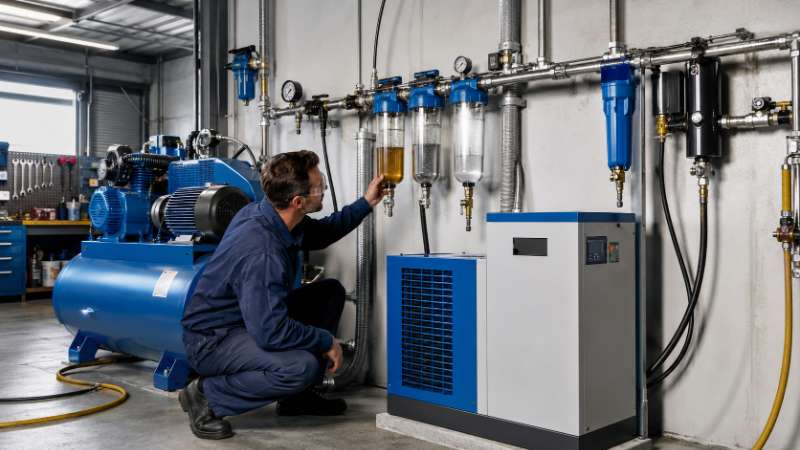
Key insights: Compressed air treatment removes water vapour before it reaches your tools and production lines. Sydney's humidity means an untreated system can push litres of condensed water into pneumatic tools and spray booths every week, stripping lubrication and ruining finishes. A refrigerated air dryer — which cools air to around 3°C to force out moisture — handles most workshops; desiccant dryers reach dew points below -40°C for spray booths and critical applications. All Air Compressors installs and services both across Sydney.
Water in your compressed air lines comes from ordinary atmospheric moisture that condenses once compressed air cools inside your pipework. Left untreated, it destroys pneumatic tools, ruins spray-finished product, and corrodes steel piping from the inside out. The fix is compressed air treatment — typically a refrigerated or desiccant air dryer sized to your compressor's output and installed after the receiver tank.
Why does water end up in compressed air lines?
Your compressor doesn't create water — it concentrates what's already in the air it draws in. Sydney's humid ambient air carries water vapour, and compressing that air raises its temperature while lowering its capacity to hold moisture as vapour.
As the compressed air cools on its way through the receiver tank and distribution piping, that vapour condenses into liquid. Without a dryer or separator in the line, the water travels straight to whatever tool or valve is downstream.
What does moisture actually damage in a compressed air system?
Three things, consistently, in Sydney workshops:
- Pneumatic tools — water strips the oil film that lubricates vanes, bearings, and cylinders, leading to metal-on-metal wear, overheating, and premature motor failure.
- Finished product — in spray painting and powder coating, moisture in the air line causes blistering, fisheyes, and poor adhesion; in packaging lines, it can compromise seals.
- Pipework itself — standing water triggers internal rust in steel or iron lines. Rust flakes then clog regulators and valves downstream, and the resulting corrosion narrows the pipe, forcing your compressor to work harder and use more power to maintain pressure.
If your team is already running line filters to catch particulate and oil carryover, moisture is usually the other half of the air-quality problem — filtration and drying are two separate jobs.
What's the difference between refrigerated and desiccant air dryers?
It comes down to how dry the air needs to be:
|
Refrigerated dryer |
Desiccant dryer |
|
|
How it works |
Cools air to ~3°C, condensing out moisture |
Absorbs moisture using a drying media |
|
Typical dew point |
Around 3°C |
-40°C or lower |
|
Best for |
General manufacturing, workshops |
Spray booths, outdoor lines, freezing conditions, critical processes |
Most factories and automotive workshops in Sydney are well served by a refrigerated dryer. Businesses running spray finishing, outdoor piping, or processes that can't tolerate any moisture usually need desiccant drying instead.
How do you know if your compressed air needs better treatment?
A few signs point to a treatment gap rather than a one-off fault:
- Water sputters out when you open a spray gun or purge a hose
- Tools feel sluggish or wear out faster than they should
- You're replacing filter elements more often than the manufacturer recommends
- Sprayed or coated product shows blistering or uneven finish
- Rust-coloured residue turns up when you drain the receiver tank
Any one of these on its own can have another cause. Two or more together usually means your dryer is undersized, ageing, or missing entirely.
A quick inspection of your filtration and dew point performance can save thousands in ruined tools and unplanned downtime — talk to our team about a compressed air system service or repair before it becomes an emergency call-out.
What actually gets checked during a compressed air treatment assessment?
A proper assessment looks past the dryer itself to the whole system: compressor intake conditions, receiver tank drainage, dryer sizing against your actual air demand, filter condition, and pipework for existing corrosion or leaks. Undersizing the dryer for peak demand is one of the most common issues we find in Sydney workshops — the dryer works fine most of the day, then gets overwhelmed the moment a spray booth or bank of tools all draw air at once.
How much does compressed air treatment cost in Sydney?
Cost depends on your compressor's output (CFM), your target dew point, whether you need a refrigerated or desiccant system, and how much of your existing pipework needs work alongside it. Because those variables differ site to site, the only reliable way to get a number is a site assessment — call 0435 166 474 and our technicians can scope it properly rather than guess from a phone description.
Frequently Asked Questions
Q: How do I know if water is a problem in my compressed air system? A: Look for water sputtering from spray guns or hose ends, sluggish or premature tool wear, more frequent filter changes than usual, or rust-coloured residue when you drain the receiver tank. Any of these on their own can point elsewhere, but two or more together usually means moisture is getting past your existing filtration or drying.
Q: What's the difference between a moisture separator and an air dryer? A: A separator catches liquid water and oil droplets that have already condensed in the line — it's a mechanical trap. A dryer (refrigerated or desiccant) actually removes water vapour before it can condense in the first place. Most systems need both: a dryer upstream and separators at points further down the line.
Q: Can I just drain my receiver tank manually instead of installing a dryer? A: Manual draining removes bulk water that's already collected in the tank, but it does nothing for the moisture still travelling through your distribution piping to your tools. For anything beyond light, occasional use, a dryer plus auto-drain valves is the standard fix, not a substitute for one.
Q: Do spray booths need a different type of air dryer than a general workshop? A: Usually yes. Spray finishing is sensitive to even small amounts of moisture, so most spray booths need a desiccant dryer reaching dew points of -40°C or lower, rather than the refrigerated dryers (around 3°C) that suit general pneumatic tool use.
Q: How often should compressed air treatment equipment be serviced? A: It depends on the equipment and how hard it's run, but as a general rule, filters and auto-drain valves need checking far more often than most businesses realise — sluggish tools or repeated filter changes are usually the first sign servicing is overdue. Our technicians can set a schedule based on your actual usage during an inspection.
Q: Does All Air Compressors service compressed air systems across all of Sydney? A: Yes — All Air Compressors provides compressed air system inspections, servicing, and repairs across Sydney, including moisture and dryer assessments, with 24/7 emergency callouts available.
Untreated moisture is one of the most common — and most avoidable — causes of pneumatic tool failure, spoiled finishes, and pipe corrosion in Sydney workshops. Whether the fix is a properly sized refrigerated dryer, a desiccant system for critical applications, or simply catching a dryer that's already failing, it starts with knowing your system's actual dew point performance. Speak with All Air Compressors for a straight assessment of your compressed air treatment setup before it costs you tools or downtime.
Call Peter Bagot: 0435 166 474, All Air Compressors P/L — 24/7 Emergency Repairs, Preventative Servicing & Line Installation Across Sydney