
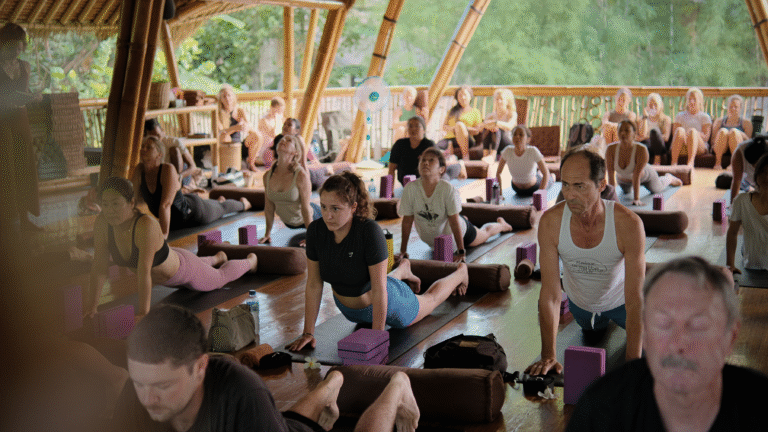
The month you spend in Sanur deepens your practice, introduces you to teaching, and opens a door to a life shaped by yoga. What comes next is entirely yours to choose. Whether you want to teach professionally, specialise in a specific population, or simply keep growing, there are clear pathways forward — each recognised by Yoga Alliance and respected by studios worldwide.
Here's what's available to you after your 200-hour certification.
Why Continue Your Yoga Education?
The 200-hour training gives you a solid, well-rounded foundation. You leave with the skills to lead a class, an understanding of anatomy and philosophy, and the confidence to hold space for students at every level.
But yoga is a lifelong practice — and so is the study of it. Advanced certifications allow you to:
-
Teach more specialised populations (children, pregnant women, seniors)
-
Unlock higher-level Yoga Alliance designations that carry weight with employers
-
Deepen your understanding of areas that fascinated you most during training
-
Build credibility and standing as a professional teacher
You don't need to pursue any of these paths immediately. Many graduates spend their first year teaching, building hours, and finding their feet — which is exactly what's recommended. When you're ready, the options below will be waiting.
Experienced Registered Yoga Teacher 200 (E-RYT 200)
The E-RYT 200 is the natural next step for anyone who completed their 200-hour YTT and has since been teaching regularly.
To qualify, you need:
-
A completed 200-hour Yoga Teacher Training at a Yoga Alliance-registered school
-
At least 2 years of teaching experience post-graduation
-
A minimum of 1,000 contact teaching hours
One important note: all 200 training hours must come from the same school. Hours from different trainings cannot be combined to meet the requirement — which is one reason choosing a quality, Yoga Alliance-accredited program like PONO's matters from the start.
The E-RYT 200 signals to students and studios that you're not just certified — you're experienced. It also makes you eligible to serve as a lead trainer in future 200-hour programs, opening doors to a teaching career within the teacher training world itself.
Registered Yoga Teacher 500 (RYT 500)
The RYT 500 is the most widely recognised advanced designation in yoga — and the one most likely to expand your professional opportunities.
To earn it, you need:
-
A completed 200-hour Yoga Teacher Training
-
An additional 300-hour advanced training (registered with Yoga Alliance)
-
The two programs can be completed at the same school or at different accredited schools
The 300-hour curriculum typically goes deeper into yoga philosophy, advanced sequencing and class design, pranayama, meditation, and the business of yoga — areas that a 200-hour program introduces but doesn't have time to fully explore.
If you know you want to teach full-time, or eventually lead your own training programs, the RYT 500 is the clear path. It's a designation that opens doors at studios, retreat centres, and training schools internationally.
Registered Children's Yoga Teacher (RCYT)
If working with young people lights you up, the RCYT pathway offers a deeply rewarding specialisation.
Teaching yoga to children is a distinct skill set. Age-appropriate sequencing, creative engagement, managing group energy, and understanding how growing bodies move are all areas the RCYT program addresses specifically.
To qualify, you need:
-
A completed 200-hour Yoga Teacher Training
-
A 95-hour Children's Yoga Teacher Training registered with Yoga Alliance
-
30 hours of documented teaching with children, submitted to Yoga Alliance upon completion
The RCYT opens up school programs, family classes, community yoga, and children's wellness retreats. It's also a beautiful complement for anyone interested in supporting child development through mindful movement.
Registered Prenatal Yoga Teacher (RPYT)
Pregnancy is one of the most significant physical and emotional transitions in a person's life — and yoga can be a profound support throughout it. The RPYT certification trains you to guide expectant mothers safely and thoughtfully through every trimester.
The curriculum covers prenatal anatomy and physiology, modifications for each stage of pregnancy, breathwork for labour preparation, and postpartum recovery considerations.
To earn the RPYT designation, you need:
-
A completed 200-hour Yoga Teacher Training
-
An 85-hour Prenatal Yoga Teacher Training registered with Yoga Alliance
-
30 hours of prenatal teaching submitted to a Registered Prenatal Yoga School
Prenatal yoga is in consistently high demand — from dedicated prenatal studios to hospital wellness programs, birth centres, and community health initiatives. If you feel called to support women during pregnancy, this is a meaningful and needed specialisation.
How to Choose Your Next Step
There's no single right answer — and no rush. The best next step depends on where you are in your teaching journey and where you want to go.
A few questions worth sitting with:
-
Are you teaching regularly? If yes, the E-RYT 200 may be the most natural milestone to work toward.
-
Do you want to teach professionally long-term? The RYT 500 gives you the most versatility and career credibility.
-
Is there a specific population you feel drawn to? Children and prenatal are two of the most in-demand specialisations globally.
-
Are you still finding your feet? That's completely fine. Come back to daily classes, keep your practice alive, and let the next step reveal itself.
At Power of Now Oasis, we stay connected to our graduates. Whether you're ready to plan your next training or just want to return for a week of practice and reflection, our doors — and our beachfront shala — are always open.
Keep Going
The 200-hour is the foundation. Everything built on top of it is yours to shape.
If you're ready to explore what comes next, get in touch with our team — we're happy to talk through your options and help you find the path that fits. You can also learn more about how our 200-hour YTT program prepares you for all of these advanced pathways, or browse the PONO blog for more on teaching, practice, and life after training.