
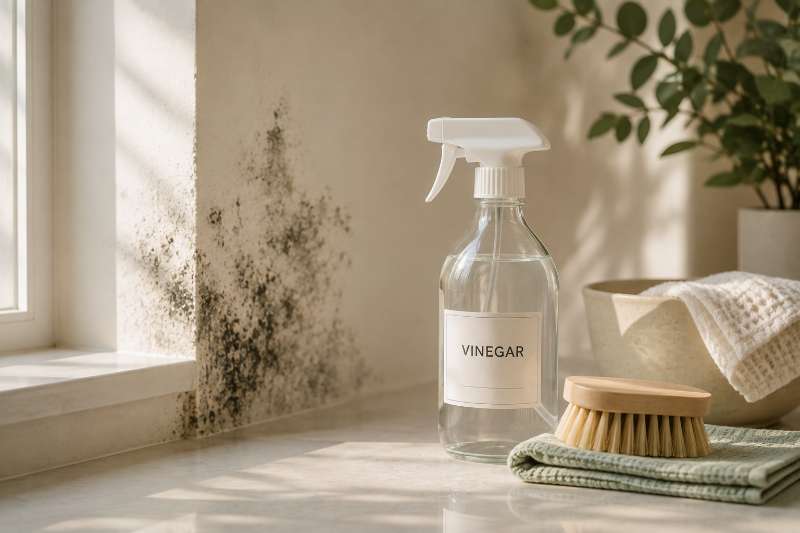
Does Vinegar Kill Mould? Mould Myths vs Facts
Does vinegar kill mould? Yes — white vinegar kills most common household mould, and on porous surfaces like painted walls and plaster it often works better than bleach, because it reaches the roots rather than just removing the stain. Mould is one of those problems buried in bad advice, so this guide sorts the myths from the facts: what actually kills mould on walls, what only appears to, and how to stop it coming back for good.
Key Insights:
Vinegar works: White vinegar kills roughly 80% of household mould species and penetrates porous walls to kill the roots.
Bleach is overrated on walls: On porous surfaces bleach mainly removes the colour of the stain, leaving the mould to regrow — it's best kept for hard, non-porous surfaces like tiles.
You can't paint over it: Mould grows straight through fresh paint, even mould-resistant paint. It must be removed and the wall dried first.
Removal isn't the end: Mould returns unless you fix the moisture feeding it — that's the step most people skip.
Myth 1: "Vinegar doesn't really kill mould"
Fact: it does — and it's one of the best options for walls. White vinegar is a mild acid that kills most common mould species and, crucially, soaks into porous surfaces like plaster and painted walls to destroy the mould at the root. That's the part that matters: kill the roots and it doesn't grow back; remove only the surface and it does.
To use it, spray undiluted white vinegar directly onto the mould, leave it for at least an hour, then scrub with a stiff brush, wipe clean and dry the wall completely. No need to dilute it — full strength works best.
Myth 2: "Bleach is the best way to kill mould"
Fact: on walls, bleach mostly hides mould rather than killing it. This is the most common mould myth of all. Bleach works well on hard, non-porous surfaces like tiles, glass and grout. But on porous surfaces such as plaster and painted walls, the chlorine can't penetrate — it bleaches the stain white so the mould looks gone, while the roots survive underneath and regrow within weeks.
So if you've ever wondered why the mould keeps coming back after you bleach it, that's why. For walls, vinegar or a dedicated mould treatment is the better choice.
Safety warning: Never mix bleach with vinegar, ammonia or other cleaners. The combination releases toxic gas. Use one product at a time in a well-ventilated room, with gloves and a mask.
Myth 3: "You can just paint over mould"
Fact: painting over mould never works. Mould is a living organism, and it grows straight through a fresh coat of paint, reappearing within weeks. Even paint labelled mould-resistant won't bond to a surface that still has mould or damp in it, so the finish fails fast.
The correct order is always remove, dry, then paint. Once the wall is clean and completely dry, a mould-resistant paint made for high-humidity walls adds a genuine protective barrier. Skipping the removal step is the single most common reason mould reappears after a repaint — and it's exactly where a proper job differs from a quick cover-up. Our full guide on how to get rid of mould on walls permanently walks through the whole process.
Myth 4: "Mould on walls is just a cosmetic problem"
Fact: mould can affect both your health and your home. Mould spores can trigger allergies, coughing and breathing problems, and they affect people with asthma or weakened immunity more strongly. Left unchecked, mould also breaks down plaster, timber and paint over time, so a patch that starts cosmetic can turn structural.
It's also a signal. Mould on walls almost always means there's a moisture problem behind it — condensation, a leak, or rising damp — so it's worth reading the signs of mould behind paint as an early warning rather than just a stain to wipe away.
Myth 5: "Once you remove mould, it's gone for good"
Fact: mould comes back unless you fix the moisture. This is the myth that costs people the most time. Cleaning removes the mould you can see, but not the damp that grew it. If the moisture source stays — poor ventilation, condensation on cold walls, a slow leak — the mould returns to the same spot every time.
Permanent removal is really three steps: kill and remove the mould, fix the moisture source, then protect the surface with the right paint. Miss the middle step and you'll be scrubbing the same wall next winter.
Myth 6: "A little mould isn't worth worrying about"
Fact: small patches are manageable, but some mould needs a professional. A small area of surface mould — under about one square metre — is usually safe to treat yourself with vinegar, gloves and a mask. But you should call a professional if the mould covers a larger area, keeps returning after treatment, or if anyone in the home has asthma, allergies or another respiratory condition.
Recurring or widespread mould usually points to a hidden damp problem that a surface clean can't solve, and it needs the source fixed and the walls prepared and repainted correctly.
Frequently asked questions
Does vinegar kill mould better than bleach? On porous surfaces like painted walls and plaster, yes. Vinegar penetrates and kills the mould at the root, while bleach mostly removes the surface stain and leaves the roots to regrow. Bleach is more effective on hard, non-porous surfaces such as tiles and grout.
How long do you leave vinegar on mould? Spray undiluted white vinegar onto the mould and leave it for at least an hour before scrubbing and wiping clean. Then dry the surface completely, because any leftover moisture lets the mould return.
Does bleach kill mould on walls? Not effectively. On porous walls bleach removes the colour of the stain so the mould looks gone, but the roots survive underneath and regrow. That's why mould so often comes back after bleaching.
Can you paint over mould with mould-resistant paint? No. Mould grows through fresh paint, and mould-resistant paint won't bond to a surface that still has mould or damp in it. Always remove the mould and dry the wall first, then use the paint as protection.
Why does mould keep coming back after I clean it? Because the moisture feeding it is still there. Cleaning removes the visible mould, not the damp. Until you fix the ventilation, condensation or leak causing it, the mould will keep returning to the same spot.
The short version: vinegar genuinely kills mould, bleach mostly hides it on walls, and painting over it never works — remove it, dry the wall, fix the damp, then protect it. If the mould in your home keeps coming back, or you'd like the affected walls repaired and repainted properly, Decor8 offers free onsite quotes across the Blue Mountains, Western Sydney and the Hills District. You can request a quote or call John on 0404 842 708.
Decor8 Painting & Decorating — servicing the Blue Mountains, Western Sydney & the Hills District.