
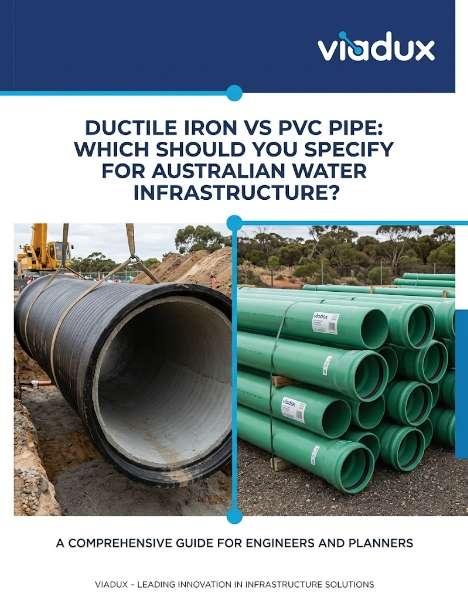
Choosing between ductile iron and PVC pipe is not just a materials decision — it is a risk management decision. Get it wrong and you are looking at premature failures, pressure testing issues, non-compliance with water authority standards, or a costly reline within 15 years.
In Australia's water infrastructure sector, procurement cycles on major projects often begin 6 to 12 weeks before an RFQ is formally issued. Engineers are building preferred supplier lists and making specification decisions well before commercial conversations start. That means the right material call needs to happen early — and it needs to be defensible.
This guide gives you a plain-English breakdown of both materials, where each excels, where each falls short, and how to make the right call for the project in front of you.
QUICK COMPARISON AT A GLANCE
Pressure rating: Ductile iron handles up to PN64 and above. PVC is typically rated to PN12.5 through PN25.
Diameter range: Ductile iron runs from DN80 to DN2000 and beyond. PVC is practical up to around DN630.
Design life: Ductile iron is engineered for 100 years or more. Quality PVC in the right conditions can deliver 50 years or more.
Impact resistance: Ductile iron is excellent and handles bedding variation well. PVC is moderate and more sensitive to point loads.
Surge and water hammer: Ductile iron is highly resistant. PVC is more vulnerable and needs careful design consideration.
Corrosive soils: Ductile iron requires polyethylene sleeving or protective lining in aggressive environments. PVC is naturally resistant to most soil chemicals.
Upfront cost: Ductile iron is higher. PVC is lower.
Lifecycle cost: Ductile iron is lower over time due to longer service life and less maintenance. PVC varies depending on conditions.
Australian Standards: Ductile iron is manufactured to AS/NZS 2280. PVC falls under AS/NZS 1477 and AS/NZS 4765.
Neither material is universally superior. The right answer depends on operating pressure, soil conditions, pipe diameter, project budget model, and the water authority requirements at your specific location.
DUCTILE IRON PIPE — WHERE IT EXCELS AND WHERE IT HAS LIMITS
Ductile iron has been the backbone of Australia's high-pressure water transmission networks for decades. Its mechanical strength, pressure capability, and long service life make it the default specification for demanding civil infrastructure.
It excels in high-pressure transmission mains at PN16, PN20, PN25, and above. It is the dominant material for large-diameter trunks from DN375 upwards. The Hamilton-Grampians pipeline in Victoria — 52 kilometres of TYTON DN375 PN20 ductile iron — is a well-known Australian example of what this material delivers at scale.
In urban environments with variable loading, ductile iron's superior beam strength handles traffic loads, trench instability, and shallow cover better than alternatives. For critical assets where the design life requirement is 80 to 100 years or more, ductile iron is the proven choice. It also performs well on river crossings and difficult terrain, where its flexibility factor allows for ground movement accommodation.
On the limitations side, ductile iron has a higher material and installation cost than PVC on a per-metre basis. It is heavier, requiring appropriate plant for larger diameters. In aggressive soil environments with high chloride levels or low soil resistivity, polyethylene sleeving or cement mortar lining is required. This is standard practice but must be explicitly specified.
Ductile iron pipes and fittings for water infrastructure in Australia are manufactured to AS/NZS 2280. WSAA Product Specifications WSA 101 govern approved products and installation requirements for water authority projects.
PVC PIPE — WHERE IT EXCELS AND WHERE IT HAS LIMITS
Unplasticised PVC and modified PVC remain workhorses for distribution networks across Australia. Lower installed cost and good chemical resistance make PVC the right specification for a significant segment of water infrastructure work, when the conditions suit it.
PVC performs well on reticulation networks and distribution mains operating at lower pressures up to PN16, particularly in smaller diameters from DN100 to DN300. It has inherent resistance to most soil chemicals, acids, and alkalis without additional protection, which gives it a natural advantage in chemically aggressive ground conditions. For residential and light commercial reticulation, PVC delivers reliable performance within its pressure and diameter envelope.
The limitations matter. PVC is not suitable for high-pressure transmission mains where surge events can cause catastrophic failure. It degrades under UV exposure if left unprotected above ground. Thermal expansion is significant in Australian climate conditions and must be designed for. PVC is more sensitive to point loads and poor bedding than ductile iron, and above DN630, the structural case for moving to ductile iron becomes compelling.
PVC pressure pipes for water supply are manufactured to AS/NZS 1477. Modified PVC products fall under AS/NZS 4765.
AUSTRALIAN CONDITIONS THAT AFFECT YOUR CHOICE
Australia's geography and climate create challenges that generic international guidance does not always account for.
Eastern and southern Australia have some of the most highly reactive clay soils in the world, particularly in Victoria, South Australia, and western New South Wales. Seasonal ground movement from these reactive clays imposes bending loads on buried pipes that PVC handles poorly at larger diameters. Ductile iron's beam strength and TYTON push-in flexible joints are well-suited to these conditions.
In Queensland, the Northern Territory, and northern Western Australia, high ambient temperatures make PVC more susceptible to thermal expansion and UV degradation. Ductile iron is essentially unaffected by Australian ambient temperature ranges.
Coastal and industrial areas with high-chloride soils, acidic ground from mining activity, or stray current environments require careful assessment. Ductile iron in these zones needs polyethylene sleeving to AS 3681 or zinc-rich coatings. PVC has better raw chemical resistance but may not be structurally appropriate for the pressure class required.
Western Australia has areas of moderate seismic activity. TYTON-jointed ductile iron provides angular deflection of up to 5 degrees per joint, giving it inherent seismic accommodation that is often overlooked in standard material selection processes.
UPFRONT COST VS LIFECYCLE COST
The most common mistake in pipe material selection is optimising for upfront installed cost rather than whole-of-life cost. On assets with 50 to 100 year design lives, this is a significant and avoidable error.
Ductile iron has a higher material and installation cost per metre. PVC is cheaper to buy and faster to install. However, ductile iron typically requires far less maintenance over its service life, is designed to last 100 years or more in appropriate conditions, and carries a lower risk of failure in high-pressure or reactive soil environments.
For major water authority transmission infrastructure, lifecycle cost analysis almost always favours ductile iron. For distribution networks in standard soil and pressure conditions, PVC can deliver comparable lifecycle value at lower capital cost.
When presenting material selection to a water authority, always include a 30-year and 50-year cost model, not just the installed cost. Authorities are increasingly requiring whole-of-life cost submissions as part of contractor specifications.
WATER AUTHORITY APPROVAL REQUIREMENTS
Material selection does not happen in isolation from regulatory requirements. Every state and territory water authority maintains approved product lists and installation specifications that govern what can be used on their networks.
The key Australian standards are AS/NZS 2280 for ductile iron pipes and fittings, AS/NZS 1477 for PVC pipes and fittings for pressure applications, and WSAA WSA 101 for ductile iron product specifications on water authority projects. WaterMark Certification is mandatory for plumbing and drainage products used in regulated applications.
Sydney Water, Melbourne Water, SEQ Water, SA Water, and Water Corporation WA each maintain supplementary specifications that sit above the Australian Standards. These must be reviewed project by project. Approved product lists are updated periodically and vary significantly between authorities and between pressure classes within the same authority. Always confirm requirements directly before finalising your specification.
WHICH TO SPECIFY AND WHEN
Specify ductile iron when operating pressure exceeds PN16, when diameter is DN375 or above, when design life is 80 to 100 years or more, when reactive clay or unstable soils are present, when there is high traffic loading or shallow cover, on river crossings and difficult terrain, on major water authority transmission mains, when surge or water hammer is a design consideration, or when the asset is classified as critical infrastructure.
Specify PVC when operating pressure is PN16 or below, when diameter is DN300 or below, in chemically aggressive soils without high pressure, on residential or light commercial reticulation, on distribution networks in standard conditions, or when budget constraints are a primary driver and the project conditions fall within PVC's performance envelope.
Some projects sit between these clear-cut cases. DN300 to DN375 at PN12.5 to PN16 in reactive soils with a 50-year design life brief is a genuine engineering judgment call. It requires site-specific soil data, authority requirements review, and lifecycle cost modelling. Engage your pipe supplier early — a good technical team will help you build the specification case, not just sell you product.
CONCLUSION
Ductile iron and PVC both have their place. The mistake is treating the choice as purely a cost decision rather than a performance and risk decision.
For major transmission infrastructure and high-pressure applications, ductile iron is the defensible specification. For distribution networks in standard conditions, PVC delivers solid lifecycle value at lower capital cost.
Make the material selection early, involve your supplier at the specification stage, and document your decision before the RFQ goes out.
Need help specifying the right pipe for your project?
Viadux's technical team supports civil engineers and procurement managers across Australia on material selection and project supply.