
Most people don't notice hair loss until it's already been progressing for months, sometimes years. That's not a coincidence. The early signs are easy to dismiss: a slightly wider part, more hair on the shower floor, a ponytail that feels thinner than last year. These aren't random inconveniences. They are measurable, clinically recognised signals that your follicles are under stress.
The earlier you act, the more hair you keep.
A 2025 Canadian consensus published in PubMedfound that androgenetic alopecia, the most common type of hair loss, affects 40 to 50% of Canadian men and women by age 50. In men, it can begin as early as the teenage years. Up to 40% of women experience visible thinning by age 50. The window for effective intervention is widest at the beginning. This guide is designed to help you use it.
TL;DR, Key Takeaways :
Hair loss often begins years before it becomes obviously visible. Early signals matter.
40 to 50% of Canadian men and women experience androgenetic alopecia by age 50 (PubMed, 2025).
Losing 50 to 100 hairs per day is normal; consistently more than that is a warning sign.
Key early signs: wider part line, more scalp visible at temples, increased shedding, thinner ponytail.
PRP for hair achieves a 70 to 80% success rate in early to moderate hair loss. Results drop significantly in advanced stages.
The single most important factor in treatment outcomes is how early you start.
Book a complimentary consultationat Beyond Medical Aesthetics, Markham.
Table of Contents
• What Are the Very First Signs of Hair Loss Before It Becomes Visible?
• What Is the Difference Between Normal Hair Shedding and Actual Hair Loss?
• What Causes Early Hair Loss in Women and Men in Their 20s and 30s?
• How Is Early Hair Loss Diagnosed and What Should You Expect at a Consultation?
• What Is the Most Effective Treatment for Early Hair Loss in Markham and Toronto?
• Ready to Address Your Hair Loss Early?
• Frequently Asked Questions
What Are the Very First Signs of Hair Loss Before It Becomes Visible?
The challenge with early hair loss is that most of its first signals are things you can feel before you can clearly see them. The scalp itself often gives the first clues:
• More hair in unexpected places: In the shower drain, on your pillow, wound around your hair brush. Losing 50 to 100 hairs per day is within the normal range, according to the American Academy of Dermatology. Consistently losing significantly more than that, particularly if you notice a change from your usual baseline, is a clinically meaningful signal.
• A wider part line: For women especially, the part line is one of the earliest places hair thinning becomes visible. If your part looks broader under direct light or in photographs than it did a year ago, that change is real and worth investigating.
• A thinner ponytail or bun: If your ponytail circumference has decreased noticeably, that reflects a genuine reduction in the total number of active hair follicles contributing to your overall hair volume.
• Increased scalp visibility at the temples or crown: Light catching the scalp through the hair, or the crown looking less dense in certain lighting conditions, is among the earliest visual indicators of androgenetic alopecia in both men and women.
• Miniaturised hairs: Shorter, finer, lighter hairs growing in areas where thicker hairs previously grew are a sign that follicles are in the process of miniaturising, a key biological mechanism of pattern hair loss.
None of these signs, on their own, confirms a diagnosis. But any combination of them, especially if they have changed over the past six to twelve months, warrants a proper clinical assessment.
What Is the Difference Between Normal Hair Shedding and Actual Hair Loss?
This is one of the most common questions, and one of the most common sources of anxiety around hair loss, and it deserves a direct answer.
Normal hair shedding is part of the natural hair growth cycle. Each follicle cycles through three phases: anagen (active growth, lasting 2 to 6 years), catagen (transition, lasting 2 to 3 weeks), and telogen (resting and shedding, lasting approximately 3 months). At any given time, roughly 10 to 15% of your follicles are in the telogen phase, which is why losing a consistent number of hairs daily is entirely normal.
Hair loss, clinically distinguishable from shedding, occurs when follicles begin to miniaturise and produce progressively shorter, finer hair until they eventually stop producing hair entirely. In androgenetic alopecia, this process is driven by the hormone DHT (dihydrotestosterone), which binds to genetically susceptible follicles and progressively shrinks them over years.
The practical distinction: shedding fluctuates (seasonal changes, post-illness, post-pregnancy) and tends to resolve. Hair loss is a progressive, directional change. The part line keeps widening, the density keeps declining. If you are unsure which category you are in, a scalp assessment with a trained clinician is the most efficient and accurate way to find out.
Not sure if what you're experiencing is shedding or true hair loss? Book a hair loss assessment at Beyond Medical Aesthetics. A proper scalp exam and history is the fastest way to know for certain.
What Causes Early Hair Loss in Women and Men in Their 20s and 30s?
Hair loss presenting in the 20s and 30s is more common than most people realise. A 2025 clinical study found the mean onset age for androgenetic alopecia was 23.9 years in men and 29.46 years in women, meaning the most common form of hair loss typically begins in a person's mid-20s, not their 50s.
Causes of early-onset hair loss include:
• Genetics: Androgenetic alopecia accounts for 95% of male hair loss and a significant proportion of female hair loss. If a parent or grandparent on either side experienced pattern hair loss, your risk is elevated.
• Hormonal changes: Postpartum hair shedding, thyroid dysfunction, polycystic ovary syndrome (PCOS), and hormonal contraceptive changes can all trigger or accelerate hair thinning in women.
• Nutritional deficiencies: Iron, ferritin, vitamin D, zinc, and biotin deficiencies are all documented contributors to hair loss. These are particularly common in women of reproductive age and can be confirmed with bloodwork.
• Chronic stress: Physical or emotional stress can push follicles prematurely into the telogen (shedding) phase, causing temporary but significant shedding known as telogen effluvium.
• Scalp health: Chronic scalp inflammation, dandruff, and seborrheic dermatitis can compromise the follicular environment and accelerate thinning in predisposed individuals.
Understanding the underlying cause matters because it directly determines which treatment approach will be most effective.
How Is Early Hair Loss Diagnosed and What Should You Expect at a Consultation?
A proper hair loss assessment goes beyond looking at the scalp. At Beyond Medical Aesthetics, an initial consultation for hair loss includes a full history, including family history, medication history, stress events, dietary changes, and menstrual or hormonal history for women, combined with a scalp examination.
In many cases, bloodwork is recommended to rule out or identify treatable contributing factors: thyroid function, iron and ferritin levels, vitamin D, zinc, and hormonal panels. These results directly influence the treatment plan.
What a clinical assessment will not do is give you a diagnosis based on looking in the mirror. Hair loss is a medical condition with multiple possible causes, some of which are entirely reversible once identified and addressed. A clinical evaluation is the only way to confirm whether what you are experiencing is androgenetic alopecia, telogen effluvium, nutritional deficiency, or a combination of factors.

What Is the Most Effective Treatment for Early Hair Loss in Markham and Toronto?
The most important clinical insight in hair loss treatment is also the most actionable one: treatment outcomes are significantly better when started early. PRP for hair loss achieves a 70 to 80% success rate in patients at early to moderate stages, and that rate drops substantially in advanced hair loss where a large proportion of follicles have already miniaturised and become non-viable, according to a 2026 analysis of PRP outcomes across multiple treatment centers.
PRP (Platelet-Rich Plasma) for Hair at Beyond Medical Aesthetics
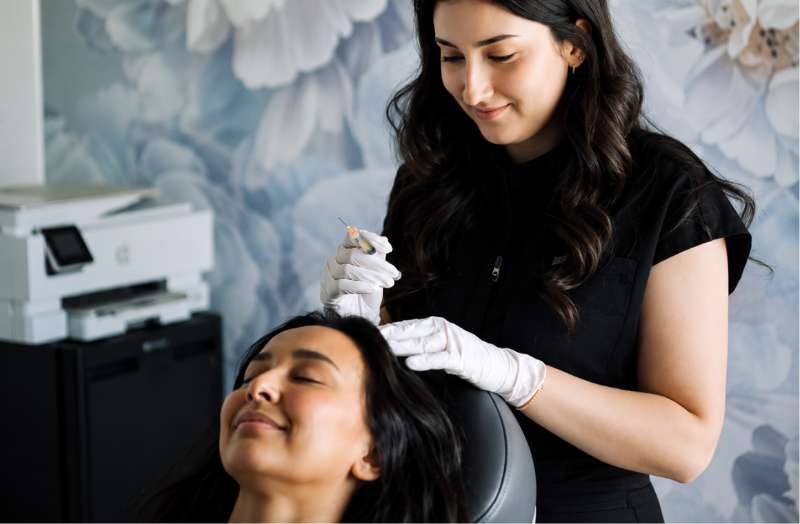
PRP therapy involves drawing a small amount of the patient's own blood, processing it to concentrate the growth factors in the plasma, and injecting that concentration directly into the scalp at the level of the hair follicles. These growth factors, including PDGF, VEGF, and IGF-1, stimulate follicular activity, extend the anagen (growth) phase, improve blood supply to the follicle, and reverse the early stages of miniaturisation.
The published clinical data is consistent:
• 30 to 40% increase in hair density after 3 to 6 months of treatment across multiple clinical trials
• 70 to 80% success rate in early-to-moderate androgenetic alopecia
• Average increase of 45.9 hairs per cm² after three initial treatments
• 76% patient satisfaction rate in meta-analyses of PRP for hair restoration
• Apeer-reviewed systematic review and meta-analysis of nine randomized controlled trials confirmed PRP therapy produces a statistically significant increase in hair density compared to placebo
Most patients require 3 to 4 initial sessions spaced 4 to 6 weeks apart, with maintenance sessions every 6 to 12 months. Results are typically visible at 3 to 6 months, with peak improvement at 6 to 12 months.
Learn more about PRP for hair at Beyond Medical Aesthetics.
Complementary Approaches
PRP is most effective as part of a broader strategy. Depending on your assessment, your clinician may also discuss:
• Scalp microneedling: Stimulates circulation and collagen production at the follicular level, and enhances PRP absorption when performed in combination.
• IV Vitamin Drip therapy: If nutritional deficiencies are identified as a contributing factor, targeted IV supplementation can address them efficiently.
• Medical management: Topical minoxidil remains a validated first-line option, particularly effective when combined with PRP.
Ready to Address Your Hair Loss Early?
Hair loss is not inevitable, and it is not something you have to wait until it becomes obvious to address. The early signs of hair loss — a slightly wider part, increased shedding, a thinner ponytail — are your body's earliest and most actionable signals. Acting on them, rather than waiting to see if things get worse, is the clinical decision that produces the best long-term outcomes.
At Beyond Medical Aesthetics in Markham, our registered-nurse-led team provides personalised hair loss assessments and evidence-based treatment plans for clients across Toronto and the GTA. Whether you are just beginning to notice changes or have been concerned about your hair for a while, the right time to have a proper assessment is now, not after further progression.
Book your complimentary hair loss consultation
Frequently Asked Questions
How many hairs falling out per day is considered normal?
Losing between 50 and 100 hairs per day is within the normal range, according to the American Academy of Dermatology. This reflects the natural telogen (resting and shedding) phase of the hair cycle. A consistent, noticeable increase beyond your personal baseline, particularly accompanied by changes to your part line or ponytail volume, is the signal to seek a clinical assessment rather than the absolute number itself.
Can early hair loss be stopped or reversed?
In many cases, yes, particularly when caused by nutritional deficiencies, hormonal changes, or stress-related telogen effluvium, which are often fully reversible once the underlying cause is addressed. Androgenetic alopecia (pattern hair loss) is progressive and not currently curable, but it can be significantly slowed and managed with early intervention. PRP therapy, medical management, and scalp treatments are most effective when started while a meaningful proportion of follicles are still active.
Is PRP for hair loss painful?
The PRP procedure involves a series of small injections into the scalp, typically preceded by topical numbing to ensure comfort. Most patients describe mild pressure or brief sensations during the injections rather than significant pain. There is no required downtime. Most clients return to normal activity the same day.
How long does it take to see results from PRP hair treatment?
Most patients begin to notice reduced shedding within 4 to 8 weeks, with visible density improvements at 3 to 6 months. Peak hair density improvement typically occurs at 6 to 12 months following the initial treatment course. Results are progressive and continue to improve with maintenance sessions.
What is the difference between male pattern and female pattern hair loss?
Male pattern baldness (androgenetic alopecia) typically begins with a receding hairline and thinning at the crown, progressing to broader baldness over time. Female pattern hair loss usually presents as diffuse thinning across the top of the scalp and a widening part line, without the receding hairline pattern common in men. Both are driven by genetic and hormonal factors, and both respond to early PRP treatment.