
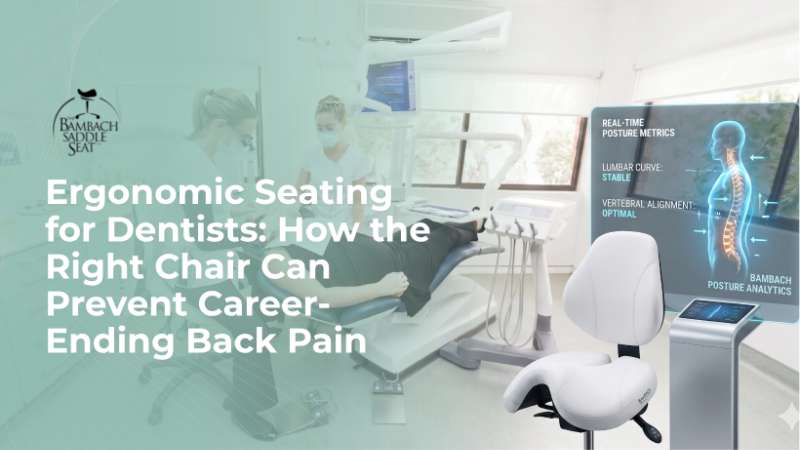
Ergonomic Seating for Dentists: How the Right Chair Can Prevent Career-Ending Back Pain
Key Takeaways:
-
Up to 80% of dental professionals experience musculoskeletal disorders (MSDs) during their careers, often leading to early retirement.
-
Traditional dental stools with a flat seat pan force a 90-degree hip angle, leading to posterior pelvic tilt and hazardous spinal compression.
-
Saddle seating, operating on a 135-degree open hip angle, promotes an anterior pelvic tilt, preserving the spine’s natural "S" curve and drastically reducing disc load.
-
Investing in authentic, anatomically contoured saddle chairs enhances practitioner longevity, improves clinical precision, and reduces practice downtime.
Dentistry is a profession of millimetres. Every day, dentists, oral surgeons, and dental hygienists perform highly precise, demanding procedures within the incredibly confined space of the human mouth. While the focus is always on the patient's oral health, the physical toll this precision takes on the practitioner is often overlooked until it is too late.
For decades, chronic back, neck, and shoulder pain were accepted as an unavoidable occupational hazard of the dental profession. However, modern ergonomic science has proven that career-ending musculoskeletal pain is not inevitable. The key to practitioner longevity lies in the biomechanics of seated posture.
This comprehensive guide explores the clinical evidence surrounding musculoskeletal disorders (MSDs) in dentistry, explains the anatomical science of saddle seating, and provides practice owners with a definitive buyer’s guide for choosing the right ergonomic equipment.
The Clinical Reality: Musculoskeletal Disorders (MSDs) in Dentistry
The prevalence of musculoskeletal disorders among dental professionals is alarmingly high. Clinical studies and industry surveys consistently show that between 60% and 80% of dentists and hygienists experience chronic pain at some point in their careers. The most common areas affected are the lumbar spine (lower back), the cervical spine (neck), and the shoulder girdle.
Why is dentistry so physically punishing? The answer lies in the unique postural demands of the job:
-
Static Posturing: Dentists often hold their bodies in fixed, rigid positions for extended periods while executing complex fine-motor tasks. This static muscle loading restricts blood flow, leading to rapid muscle fatigue and micro-trauma.
-
The "Dentist's Hunch": To gain optimal visual access to the oral cavity, practitioners frequently lean forward, twist their torsos, and tilt their heads out of neutral alignment.
-
Repetitive Strains: The continuous shifting between the patient, the instrument tray, and the curing light exacerbates asymmetrical strain on the body.
Over time, these factors culminate in repetitive strain injuries (RSIs), tension headaches, sciatica, and severe disc degeneration. For practice owners, MSDs result in reduced clinical hours, cancelled appointments, costly workers' compensation claims, and in severe cases, the premature end of a highly skilled professional's career.
The Biomechanics of Seating: Why Traditional Dental Stools Fail
To understand how to prevent MSDs, we must examine the biomechanics of traditional seating.
Standard dental stools feature a flat seat pan that creates a 90-degree angle between the torso and the thighs. When a human sits at a 90-degree angle, the thigh bones (femurs) act as levers that pull the pelvis backwards. This is known as a posterior pelvic tilt.
When the pelvis tilts backwards, the natural, healthy curve of the lower back (the lumbar lordosis) is completely flattened. The spine is forced into an unnatural "C" shape. This posture has devastating structural consequences:
-
Increased Disc Pressure: The anterior (front) portions of the intervertebral discs are compressed, pushing the jelly-like nucleus of the disc backwards toward the spinal nerves. This is the primary mechanism for bulging or herniated discs.
-
Ligament Strain: The ligaments supporting the spine are stretched beyond their neutral zone, causing inflammation and pain.
-
Core Deactivation: The "C" slump disengages the deep core muscles, forcing the superficial back muscles to work overtime to keep the practitioner upright, leading to severe fatigue and spasms.
Furthermore, traditional flat stools make it difficult to get close to the patient. The practitioner’s knees clash with the dental chair, forcing them to lean even further forward and compounding the spinal strain.
The Science of Saddle Seating: Transforming Pelvic Position and Spinal Load
The ergonomic solution to the dental posture crisis was pioneered not in a furniture factory, but by an Australian Occupational Therapist named Mary Gale, who developed the original Bambach Saddle Seat. The design is rooted in the biomechanics of equestrian posture.
A scientifically designed saddle chair fundamentally changes the geometry of sitting. Here is how it protects the dental professional's body:
1. The 135-Degree Open Hip Angle
Instead of a flat 90 degrees, a true saddle chair lowers the thighs to create an open hip angle of approximately 135 degrees. This is the anatomical "position of rest" for the human body in zero gravity.
2. Anterior Pelvic Tilt and the "S" Curve
By dropping the knees below the hips, the saddle shape naturally rotates the pelvis forward (anterior pelvic tilt). This forward rotation automatically stacks the vertebrae into their natural, healthy "S" curve. The lumbar lordosis is preserved without the practitioner needing to consciously "sit up straight."
3. Balanced Spinal Loading
With the "S" curve intact, the weight of the upper body is distributed evenly across the intervertebral discs and the sit bones (ischial tuberosities), rather than being concentrated on the lower back. This dramatically reduces disc compression and the risk of sciatica.
4. Proximity to the Patient
Because the practitioner's legs are straddled and pointing downwards, their knees no longer hit the back of the patient's chair. Dentists and hygienists can pull themselves much closer to the oral cavity, eliminating the need to lean and hunch.
5. Active Core Engagement
Saddle sitting is a form of "active sitting." It naturally engages the core stabiliser muscles and opens the diaphragm, allowing for deeper, more efficient breathing and improved oxygenation to the brain during long, complex procedures.
The Dental Practice Buyer’s Guide to Ergonomic Seating
Not all stools marketed as "saddle chairs" offer true ergonomic benefits. Many generic, poorly contoured copies can actually cause nerve compression in the thighs or groin if they lack proper medical design.
For dental practice owners and individual professionals looking to invest in their health, here is what to evaluate when purchasing a saddle chair:
1. Anatomical Contouring and Custom Sizing
The human pelvis varies greatly in width and shape. A one-size-fits-all approach does not work for clinical ergonomics. The chair must feature distinct, anatomically accurate contours designed by healthcare professionals. Look for manufacturers that offer multiple seat sizes (e.g., small, medium, large, and extra-large) to ensure the practitioner’s sit bones are properly supported without creating friction on the inner thighs.
2. Height and Tilt Adjustability
Dental professionals come in all heights, and the seat must accommodate this to achieve the crucial 135-degree hip angle. Ensure the chair has customisable gas stem heights. Additionally, the seat pan must have an adjustable tilt mechanism, allowing the practitioner to fine-tune the anterior pelvic tilt to their specific comfort level.
3. Infection Control and Upholstery
In the modern dental surgery, infection control is paramount. The seating must comply with strict hygiene standards. Look for chairs upholstered in premium, medical-grade vinyl that is completely seamless (or has minimal, sealed seams) to prevent the ingress of fluids and bacteria. The material must be robust enough to withstand constant wiping with clinical-grade disinfectants without cracking or degrading.
4. Footprint and Manoeuvrability
Space around a dental chair is tight. The base (the star-shaped bottom) of the saddle chair should have a compact footprint to prevent tripping hazards and interference with the foot pedals of the dental unit. High-quality, free-rolling castors are essential, allowing the practitioner to glide smoothly around the patient's head without twisting their spine.
5. Certifications and Warranties
Ergonomic seating is a long-term investment in your practice's productivity. Demand evidence of commercial durability. In Australia, look for AFRDI (Australasian Furnishing Research and Development Institute) Level 6 Certification, which guarantees the chair can withstand severe commercial use. A strong warranty (e.g., 5 years) on all components is a hallmark of a quality clinical device.
Conclusion: Invest in Your Long-Term Health
Your body is your most valuable clinical instrument. Ignoring the early warning signs of musculoskeletal pain can lead to chronic conditions that compromise both the quality of your dental work and the length of your career.
By upgrading to a scientifically validated, OT-designed saddle chair, you change the fundamental biomechanics of your daily practice. You eliminate the devastating posterior pelvic tilt, restore your spine's natural strength, and gain closer, safer access to your patients.
Don't let poor seating dictate your professional future. Discover the seating solution trusted by thousands of dental professionals worldwide.
Explore our full range of customisable clinical seating and protect your posture today. Visit our dedicated hub: Discover the Bambach Dental Saddle Chair.
Dental Saddle Chairs FAQs
Will a saddle chair cure my existing back pain?
While a saddle chair is not a medical "cure" for diagnosed spinal conditions, it is a highly effective tool for pain management and prevention. By correcting your pelvic tilt and restoring the natural "S" curve of your spine, it removes the mechanical stress that causes most postural back pain in dentistry. Many dental professionals report a significant reduction or complete elimination of their daily pain after switching to a genuine, anatomically designed saddle chair. However, for severe or pre-existing injuries, you should always consult your physiotherapist or medical specialist.
Does it take time to get used to sitting in a saddle chair?
Yes, there is typically a short acclimatisation period. Because a saddle chair promotes "active sitting," you will be engaging core and postural muscles that may have weakened from years of slumping in standard, flat-pan chairs. You might experience mild muscle fatigue or slight tenderness around the sit bones (ischial tuberosities) for the first one to two weeks. This is completely normal and is simply a sign that your body is adapting to a stronger, healthier posture.
Should I choose a saddle chair with or without a backrest?
For active dental work, a backrest is often unnecessary. The open hip angle and anterior pelvic tilt created by a true saddle chair naturally align and support the spine, meaning you don't need external bracing to sit upright. However, for practitioners who perform exceptionally long procedures or those who want the option to lean back and stretch between patients, a fully adjustable backrest can provide welcome intermittent relief.
Are saddle chairs suitable for Dental Assistants (DAs)?
Absolutely. Dental assistants face unique ergonomic challenges—they often need to sit higher than the dentist to gain a clear field of vision, which frequently leads to awkward leaning and severe spinal strain. A saddle chair equipped with an extended gas stem and a supportive footring allows the DA to sit safely at a higher elevation while maintaining a stable, neutral spine and keeping their hips comfortably open.
How do I determine the correct size saddle seat for my body type?
Unlike generic flat stools, a clinical-grade saddle chair must accommodate your specific pelvic anatomy. Size selection generally depends on your height, gender, and pelvic width to ensure your sit bones are supported correctly without causing friction or pressure on soft tissues. Using a one-size-fits-all chair can actually do more harm than good. It is highly recommended to use a tailored seat calculator or consult with an ergonomic seating specialist to find the exact contour and size for your body.