
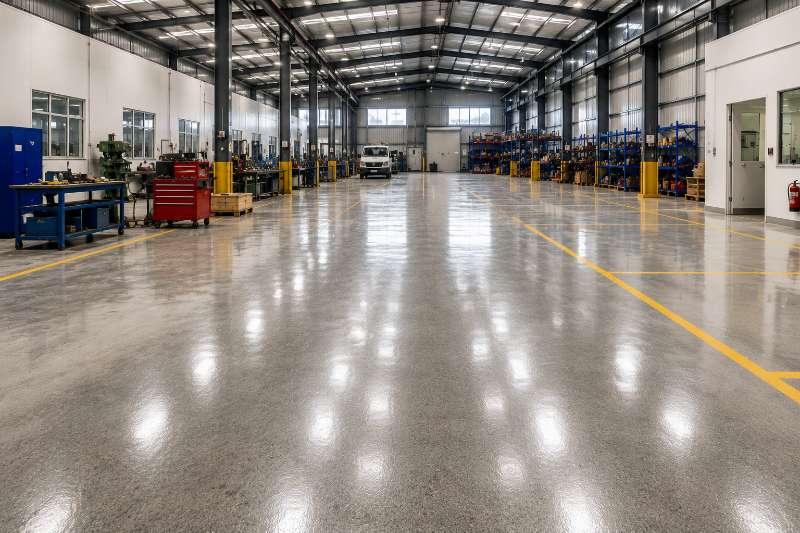
Industrial slabs generally do not fail in an instant. Dusting begins to happen under the tyres of forklifts, joint spalling occurs, oil penetrates the surface of the concrete, and mopping becomes irrelevant. Most facility managers usually begin to evaluate the costs associated with industrial epoxy flooring after many years of deterioration have already occurred.
A tired slab is seldom a write-off. Usually it is a sound substrate that needs honest assessment, repair and the right coating specification.
The floor tells you what it needs.
Prior to choosing a coating, the strength of the concrete needs to be checked. This is because the surface strength will determine the strength of the coating applied on it. A slab that crumbles under a screwdriver point will pull the coating off with it under load.
Moisture is the other big one. Concrete on ground carries vapour, and if that vapour has nowhere to go once a floor is coated, it collects at the bond line and lifts the film. Bubbling and peeling during the first year are generally due to moisture or poor preparation rather than due to the product itself.
The type of crack, previous coating, silicone, curing compound, adhesive residue, and age of the concrete slab all influence the work scope. The green concrete slab is still giving off moisture.
Preparation is most of the job.
Coatings do not stick to concrete. They stick to properly prepared concrete. The removal of laitance and contamination through diamond grinding or shot blasting and opening up the pores for mechanical bonding of the primer is achieved.
Cracks and spalls are routed out and filled before coating, because a coating film is a fraction of a millimetre thick and will tear or telegraph over an unrepaired crack. Joints are treated on their own terms, since some are designed to move.
This part of the work is unglamorous and consumes most of the labour on a professional job. It is also the main reason one floor keeps performing for years while another flakes within months.
Matching the system to the environment
Industrial epoxy flooring is more of a classification than a product itself. This type of flooring comes in many forms, ranging from hardness to chemical resistance. Thin roll-on coatings are appropriate for light-duty storage. Heavier build systems and epoxy mortars handle forklifts, pallet impact and constant abrasion in a working warehouse.
Where hot washdowns, thermal shock or aggressive chemicals are involved, as in food processing, a polyurethane cement system often outperforms standard epoxy floor coating. Rapid-cure MMA systems exist for sites that cannot give up more than a day of production.
Slip resistance is specified, not assumed. Aggregate broadcast into the topcoat lifts traction on ramps and in wet zones, and the level of texture is a trade-off between grip and ease of cleaning. Colour and line marking matter too, separating pedestrian routes from forklift runs.
When epoxy is not the right answer
Sound advice sometimes means talking a business out of a coating. A slab with active structural movement or an unresolved moisture problem will defeat any film-forming product until the cause is dealt with. If a floor is simply dusty and tired but not chemically exposed, a grind and seal may serve better for less money.
Choosing an installer
Searches for epoxy floor installers near me return plenty of options, and quotes vary enormously. The differences usually sit below the surface, in what has been allowed for.
Enquire about how the concrete will be prepared and using what machinery. Make sure moisture testing is part of the process and what will happen if high levels are indicated. Then ask which system is proposed and why it suits your operation. A contractor who inspects the slab before quoting and explains the reasoning is giving you more than a square metre rate. Confirm realistic return-to-service times as well, because foot traffic, vehicle traffic and full chemical cure all arrive at different points.
Urban Concrete Floors operates throughout Melbourne, offering industrial epoxy floor services to factories, workshops, and plants in the form of heavy-duty industrial epoxy Supafloor and warehouse floors.
Frequently Asked Questions
1. Can epoxy be applied over old concrete?
Yes, as long as it is structurally strong enough and dry. The cracks must be sealed, and the concrete must be either diamond ground or shot blasted.
2. How long does an industrial epoxy floor last?
There is no one answer. It depends upon the coating system used, thickness of the coating, surface preparation, traffic and chemicals the floor is exposed to and how often the floor is cleaned.
3. How soon can we use the floor again?
Light foot traffic usually returns before vehicle traffic, and full chemical cure takes longer again. Timing varies with the product, temperature and humidity, so confirm it with your installer.