
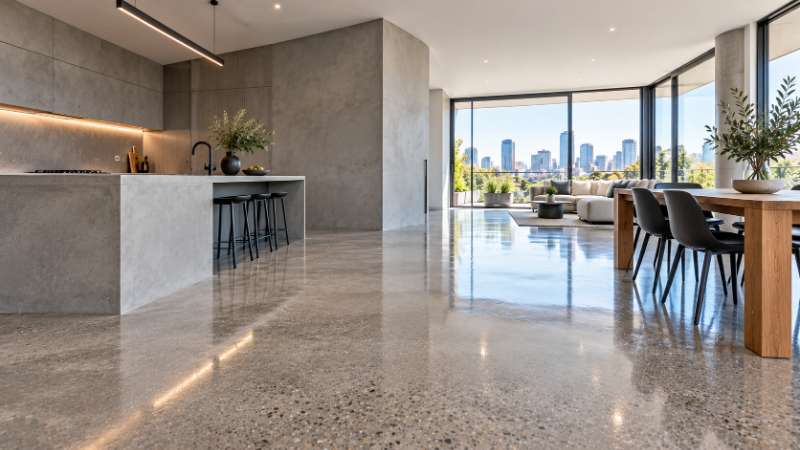
Microcement and a polished concrete floor get mistaken for each other constantly, mostly because they photograph the same. On site they could hardly be less alike.
The polished concrete is the floor on which the structure sits, ground back until it glistens. The microcement comes in drums and is troweled onto any existing floor surface. That difference decides which one a Melbourne property can take, and the rest of this guide explains how.
How a Polished Concrete Floor and Microcement Differ
True polished concrete wears no coating. Installers grind the slab with diamond tooling, harden it with a liquid densifier, then polish through ever finer grades. Grind deeper and more of the stone in the mix shows.
Owners often ask for a cement-polished floor and mean this finish. Cement is only the binder. What gets polished is the concrete, stone and all.
That’s why the pour decides most of the look. The concreter’s trowel work ends up on show. So does the stone in the mix, and now and then a boot print from another trade.
Microcement comes at the job from the opposite side. Installers trowel a pigmented paste of cement and polymers across the existing floor, coat on coat, then seal it. A standard layer finishes thinner than the tile it may be covering.
It bonds to sound tiles or tired concrete and to timber floors over a layer of sheeting. That spares the demolition. The result has no grout lines and no exposed stone, only a soft, clouded surface that still shows the trowel.
Urban Concrete Floors hand-trowells its own Microcemento finish, which builds thicker than a standard overlay. That depth helps when a stripped room has to meet the hallway besides it.
Matching the Finish to the Building
New builds on a slab suit polish, as long as the builder hears about it before the pour. Once the concrete is down, the mix and the trowel finish are whatever they are.
Renovations run differently. Plenty of older Melbourne houses sit on stumps and floorboards, with no slab to grind. There, microcement over sheeting is the practical way to get a cement polished look.
The same applies to tiled apartments and to slabs too patched to put on show. Urban concrete floors often get the call after a burnish or polish has disappointed. Its guide on whether an older slab will polish well explains what gets checked first.
Shop and cafe fit-outs hit the same wall. The lease is in progress, and there’s no desire to tear up the existing tile. For those areas where the slab is exposed and in good condition, nothing will do better for trolleys and foot traffic than a polish.
There’s also the issue of timing; an overlay comes near the end of a construction project, after the skirting and cabinetry have been installed, whereas a mechanical polish operates according to its own schedule. Both work well on heated slabs.
Where Polished Concrete and Overlays Fall Short
A polished concrete floor does not cover anything up. Cracks and traces of old plumbing trenches remain visible, as well as the joints sawed into the concrete to allow movement. An owner after flawless, even grey, work won’t get it from a mechanically polished slab.
A coating has the opposite weakness, because it follows whatever is underneath. Bounce in a timber floor or a live crack can print straight through. Old grout lines do the same unless the installer fills them flat first.
It also wears differently. Grit under chair legs marks a sealed overlay sooner than a polished slab. The sealer needs renewing now and then, more often in busy doorways.
Bathrooms deserve a plain warning. The membrane below does the waterproofing, not the coating, so the usual wet-area rules still apply.
Cost doesn’t split neatly. On a new slab planned for it, a cement-polished finish is often the cheaper one. An overlay earns its price where polishing would first mean lifting tiles and repairing the concrete beneath.
Seeing Both Before Choosing
Start with the floor that is already there, not the photo that prompted the idea. A sound slab can become a polished concrete floor. Tiles or floorboards point to an overlay instead.
Both finishes look flatter on a screen than underfoot. The floors of Urban Concrete Floors cover the city of Melbourne, but they are laid side-by-side at the Thomastown showroom that is by appointment only.
View their concrete finishes, then make an appointment for a site visit.
Frequently Asked Questions
1. Is microcement cheaper than polished concrete?
Not always. Polishing a new slab that was poured for it often costs less. Over old tiles the sums change, because an overlay skips the demolition and the slab repairs.
2. Can microcement be laid over existing tiles?
Yes, provided the tiles are sound and firmly bonded. Loose or drummy tiles come up first. Grout joints then get filled flat so the old grid can’t show through.
3. Does microcement crack?
Rarely by itself. Cracks nearly always start in the floor underneath, from slab movement or a springy timber subfloor. That’s why a good installer checks the substrate before quoting.