
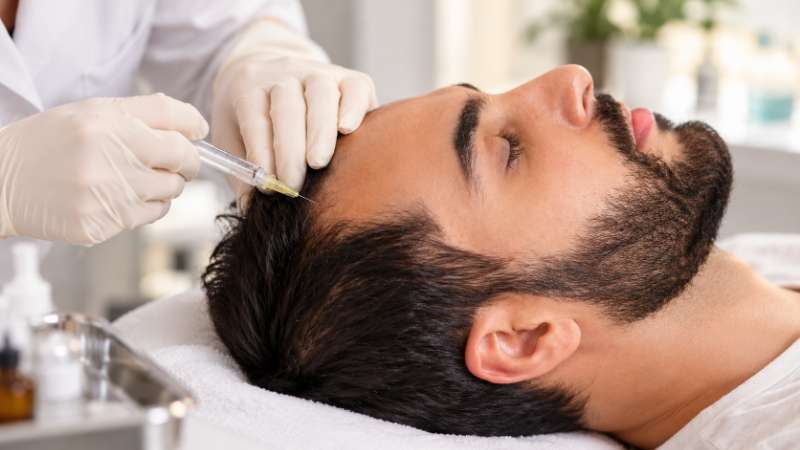
Hair loss treatment has moved well beyond a single product. Many clinics now build combination plans, and scalp microneedling with growth factors is one of the more talked-about options. Here is what the evidence says, what a session involves, and who it suits.
TL;DR: Key Takeaways
• Microneedling uses tiny needles to create controlled micro-injuries in the scalp.
• Research suggests it may add benefit when combined with minoxidil, though trial quality is modest.
• Growth factors are added on the biology of wound healing, not on direct trial proof, so treat them as an evidence-informed add-on.
• It suits early-to-moderate thinning where follicles are still active, not fully bald areas.
• Results build gradually over a series of sessions and vary from person to person.
Table of Contents
• Does Microneedling Work for Hair Loss?
• Why Add Growth Factors?
• How Does It Differ From PRP?
• What Happens in a Session?
• Who Is a Good Candidate?
• How Many Sessions, and When Do Results Show?
• The Bottom Line
Does Microneedling Work for Hair Loss?
It may help, mostly as an add-on rather than a stand-alone fix. A 2025 systematic review of 12 randomized trials (631 people with androgenetic alopecia) found that microneedling plus minoxidil increased hair count and hair diameter more than minoxidil alone. Patients and investigators were also more likely to rate the combination as improved, and side effects such as itching were mostly mild.
The caveats are real. The trials varied widely, every one was rated as having "some concern" for risk of bias, and most were run in Asia, the Middle East and North Africa. Treat the findings as encouraging rather than conclusive.
A 2025 network meta-analysis points the same way for women. Microneedling combined with minoxidil added roughly 22 more hairs per square centimetre than minoxidil alone at 24 weeks. In men, only finasteride plus minoxidil reached statistical significance, and most comparisons were rated low or very low quality. In short, microneedling looks more promising in combination than on its own.
Why Add Growth Factors?
Growth factors are signalling proteins that cells use to communicate during tissue repair. Microneedling opens small, temporary channels in the scalp, and the idea is to place those signals where follicles can reach them while the skin is already in repair mode.
It is worth being straightforward: most clinical data tests microneedling with minoxidil, not with a specific growth factor product. The growth-factor approach rests on wound-healing biology and related PRP research, so it is a reasonable add-on rather than a proven upgrade. A good provider will tell you this before you start.
How Does It Differ From PRP?
Both aim to give follicles a stronger repair and growth signal, but the source differs:
• Microneedling with growth factors: Needling combined with a topical growth factor solution. No blood draw is needed.
• PRP (platelet-rich plasma): Growth factors come from your own blood, which is drawn, spun to concentrate platelets, then injected or applied to the scalp.
The two are often combined. You can read how the second works in this guide to PRP for hair loss.
What Happens in a Session?
A typical visit follows five steps:
1. Assessment: A provider reviews your hair history, pattern of loss and medications, and may suggest bloodwork if a medical cause is suspected.
2. Preparation: The scalp is cleansed and a numbing agent is applied where appropriate.
3. Microneedling: A sterile device creates controlled micro-channels across the treatment area.
4. Growth factor application: The solution is applied to the treated scalp.
5. Aftercare: You receive guidance on washing, sun protection and when to resume hair products.
Most people describe mild tenderness during the procedure and temporary redness afterward.
Who Is a Good Candidate?
It tends to suit early-to-moderate thinning where follicles are still active, such as female or male pattern hair loss in its earlier stages. It is less likely to help in completely bald, smooth areas where follicles have been lost.
It is not for everyone. Active scalp infections, open wounds, certain skin conditions and some medical situations are reasons to wait or choose another option. If your shedding is sudden or patchy, see a physician first. For more on causes, see our guides to early signs of hair loss, hair loss in men and women’s hair thinning.
How Many Sessions, and When Do Results Show?
Hair grows slowly, so patience is part of the process. Treatment is delivered as a series, and the review above found benefit in studies running 12 weeks and longer, with larger effects in longer trials (though that difference was not statistically significant). Many people look for early changes in shedding and texture over the first few months, with fuller changes building across the series. Maintenance sessions help sustain results, and outcomes vary.

The Bottom Line
Microneedling for hair loss has encouraging, though not yet definitive, evidence, particularly alongside minoxidil. Adding growth factors is a biologically reasonable step, but it works best inside a plan built around the cause of your thinning, with realistic expectations on timing.
At Beyond Medical Aesthetics in Markham, microneedling with growth factors is offered through the Hair Restoration Program, which combines PRP and microneedling. Browse real before and after results, or book a complimentary consultation to find out whether it suits your type of hair loss. Results vary and treatment is not suitable for everyone.
Book a Complimentary Consultation at Beyond Medical Aesthetics
Beyond Medical Aesthetics
4591 Hwy 7, Unit 220A, Markham, ON L3R 1M6
Registered Nurse-Led Clinic