
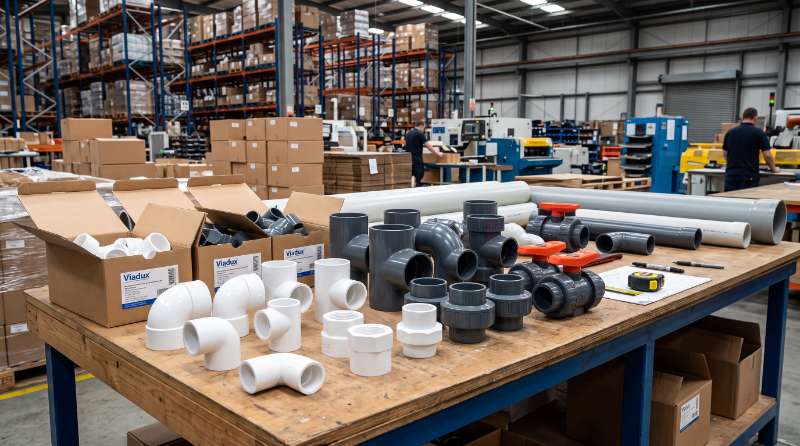
PVC pipe fittings connect, redirect and adapt PVC pipeline systems used across Australia's civil, industrial and irrigation water networks. From a 90° elbow diverting a stormwater line around an obstruction to a barrel union isolating a pump for servicing, the right fitting keeps a pressure or drainage system sealed, compliant and easy to maintain. This guide from Viadux steps through the core PVC pipe fittings categories (connectors, elbows, reducers, flanges, branch fittings and valves) so engineers, contractors and specifiers can select the correct fitting type, joint method and standard before a project reaches site.
PVC Pressure Fittings Overview
Viadux's PVC pressure fittings range covers the full set of connectors, direction changes, reducers and branch fittings used on pressurised PVC pipelines for drinking water, recycled water and pressure sewer applications. The UPVC pressure pipe fittings range is manufactured to AS/NZS 1477 and AS/NZS 4020, is lead-free and corrosion resistant, and is rated for use between 0°C and +60°C.
Rubber ring vs solvent cement fitting types
PVC pressure fittings are joined one of two ways. Solvent weld joints (SWJ) use cement to fuse the fitting to the pipe, forming a permanent, homogeneous joint. This makes SWJ well suited to smaller diameters and above-ground or industrial installations where the line won't be disturbed again. Rubber ring joints (RRJ) use an EPDM seal to allow a small amount of movement and faster assembly on larger diameters, which is why most buried reticulation mains favour RRJ over SWJ. Viadux stocks SWJ fittings from DN15 to DN150 and RRJ fittings from DN80 to DN375.
Pressure class matching requirements
Every fitting in a PVC pressure system needs to carry a pressure rating at least equal to the pipe class and the system's working pressure, including any allowance for surge or water hammer. Mixing pressure classes within the same run is one of the more common causes of joint failure found on site inspections, so it's worth confirming the PN rating printed on the fitting against the pipe class before installation, not after. Where a project specification calls for a particular class, Viadux's technical team can confirm compatibility against the relevant standard.
Connectors & Couplings
PVC pipe connectors: slip, threaded and push-fit
Connectors join two lengths of PVC pipe, or transition between fitting types, without a change in direction. Slip (socket) connectors solvent-weld directly onto the pipe, threaded connectors use a BSP thread for a mechanical, removable joint, and push-fit rubber ring connectors allow quick assembly on larger RRJ mains. The choice usually comes down to whether the joint needs to be permanent (slip), serviceable (threaded) or fast to install on a buried main (push-fit RRJ).
PVC union and PVC union fitting for disconnection
A union fitting allows a section of pipework to be disconnected and reassembled without cutting the pipe or disturbing the fittings either side of it. This is useful anywhere equipment needs periodic removal for servicing or replacement.
PVC barrel union for pump and valve isolation
The barrel union is the most common union format used either side of a pump, valve or meter. Because it can be broken and re-made with a spanner rather than a solvent weld, it lets maintenance crews isolate and remove equipment for servicing while leaving the rest of the pipeline intact.
Elbows & Direction Changes
PVC pipe elbow: 45° and 90° options
Elbows change the direction of a PVC line without introducing a separate bend section. A 90° elbow is used for a full right-angle turn, while a 45° elbow gives a gentler change of direction with lower head loss, generally the better choice where flow velocity or pump energy costs matter.
PVC pipe elbow angles: full range available
Beyond the standard 45° and 90° options, Viadux's PVC fittings range extends across the sizes and joint types set out in the technical specification sheet, covering both SWJ and RRJ ends. Every directional fitting on a pressure main generates thrust at the bend, so any elbow above ground-friction-holding size should be checked against a thrust restraint calculation. Viadux's Thrust Restraint Design tool can help size the restraint before the fitting is specified.
Reducers & Adapters
PVC pipe reducer for size transitions
A reducer steps a pipeline down (or up) from one nominal diameter to another, for example tying a smaller branch main into a larger trunk line, or transitioning to a smaller service connection. Reducers are available as concentric (centred) or eccentric (offset) fittings, with eccentric reducers typically specified where the pipe invert needs to stay level, such as on drainage runs.
PVC pipe adapter for different pipe materials
Where a PVC run needs to connect into a different pipe material (polyethylene, ductile iron or copper), a material transition adapter is required rather than a same-material fitting. Because Viadux distributes PVC, PE and ductile iron systems, mixed-material transitions on a single project can generally be sourced and specified together.
Flanges & Mechanical Joints
PVC flange and PVC pipe flange types
A PVC flange adaptor converts a plain-ended PVC pipe into a bolted flange face, allowing it to connect to a valve, pump or a flanged section of a different pipe material (a ductile iron flanged pipe, for instance) where a pressure main transitions between materials at a valve chamber.
Flange drilling standard (AS 4087)
Flange faces on Australian water infrastructure projects are almost always drilled to the AS 4087 pattern (commonly specified as PN16), which is what allows a PVC flange adaptor to bolt straight onto a ductile iron valve or fitting flange from a different manufacturer. It's worth confirming the flange class specified by the water authority or project engineer before ordering, since PN16 and PN35 flanges are not interchangeable.
Branch & Junction Fittings
PVC Y junction for drainage and branch connections
A Y junction (or Y branch) ties a secondary line into a main run at an angle, rather than at 90°, which reduces turbulence and backflow risk. This is why it's the preferred branch fitting on drain, waste and vent (DWV) lines. Viadux's non-pressure PVC pipe range for DWV applications is manufactured to AS/NZS 1260.
PVC pipe saddle for service tapping
A tapping saddle creates a branch connection into an existing pipeline, rigid or flexible, without cutting out and replacing a full section of main, making it the standard method for adding a new service connection to a live line.
Tapping saddle for PVC pipe selection
Viadux's tapping saddles are manufactured to AS/NZS 4793 and cover DN40 to DN450 at up to 1600kPa, suitable for PVC as well as ductile iron, cast iron and asbestos cement pipe. Where the branch size falls between DN100 and DN150, a multi-tap saddle offers multiple offtake points from a single fitting body rather than one saddle per tap.
Valves & Flow Control
PVC ball valve for isolation
A ball valve gives full-bore, quarter-turn isolation on a PVC line. It's the quickest way to shut a section down for maintenance or an emergency repair, with minimal pressure loss when fully open.
PVC pipe valve: gate, ball and check options
Beyond ball valves, a PVC or PVC-compatible system may call for a gate valve (for throttling or gradual shut-off), a check valve (to prevent backflow), or an air valve at high points to release trapped air during filling. Viadux's full valve range covers resilient seat, metal seat, check, butterfly, knife gate and air valve types for water and wastewater applications.
Not sure which valve configuration suits a particular pipeline layout? Get in touch with Viadux or call 1300 VIADUX (842 389) to confirm the right fitting before it's locked into a specification.
Threaded Fittings
PVC pipe thread: BSP and metric options
Threaded PVC fittings almost always use BSP (British Standard Pipe) thread in Australia, giving a mechanical, removable connection to valves, gauges, pumps and other threaded equipment without solvent welding. Metric-thread and industrial schedule 80 threaded options are also available through Viadux's Industrial Products range for higher-pressure or chemical-resistant applications.
Quick Specification Checklist
Before ordering PVC pipe fittings for a project, confirm:
-
Joint type: solvent weld (SWJ) for smaller, permanent joints or rubber ring (RRJ) for larger, buried mains.
-
Pressure class: the fitting's PN rating matches the pipe class and system working pressure, including surge allowance.
-
Flange standard: flanged connections are drilled to AS 4087 (typically PN16) unless the project specifies otherwise.
-
Thrust restraint: any bend, tee or reducer on a pressure main is checked against a thrust restraint calculation before it's installed.
-
Material compatibility: transitions between PVC, PE and ductile iron use the correct adapter rather than a same-material fitting.
Download the PVC Pipe Fittings Catalogue
PVC pipe fittings catalogue PDF
For full dimensions, pressure ratings and product codes across the PVC pressure fittings range, download the Pressure Pipe Fittings Technical Information sheet or the PVC Pressure Pipe Systems brochure. For the complete product range across PVC, PE, ductile iron, valves, clamps and couplings, the Viadux Product Range Guide covers every category in one place.
Order from Viadux
Before your next take-off is locked in, confirm fitting types, joint methods and pressure classes with the Viadux team. Getting this right at the specification stage avoids costly substitutions once material is on order. Contact your nearest branch, call 1300 VIADUX (842 389), or apply for a trade account to order PVC pipe fittings direct.