
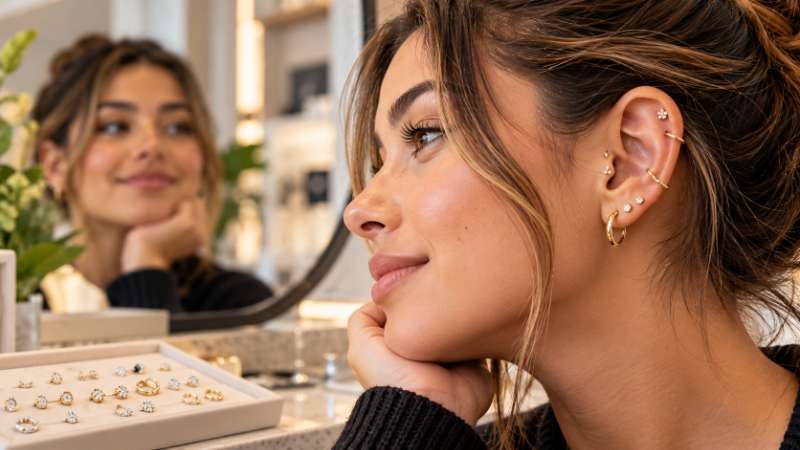
Your feed is full of them. Glittering constellations of studs climbing from lobe to helix, a single hoop hugging the conch, tiny gems tucked into a hidden helix. The curated ear has gone from niche studio talk to one of the most saved looks on TikTok. What those clips rarely show is the part that actually decides whether your stack looks good in six months: the metal in your ear and the hands that put it there. A curated ear is built over time, one healed piercing at a time, and it starts with jewellery your body will actually accept.
Key Insights
- A curated ear is a planned arrangement of piercings and jewellery designed around your anatomy, built gradually rather than all at once.
- Implant grade titanium (ASTM F136) is the safest starting material for fresh piercings because it is nickel free and highly biocompatible.
- Cartilage piercings typically take 6 to 12 months to fully heal, so stacks should be planned in stages.
- Professional piercing with single-use needles and autoclave-sterilised tools is the only safe route. Home kits, piercing guns and safety pins are never okay.
What Is a Curated Ear?
A curated ear is a deliberate mix of piercing placements and jewellery styles planned around the shape of your ear, so every piece works together instead of looking random.
Think of it like designing a tattoo sleeve. Your piercer looks at your lobe size, the fold of your helix, how deep your conch sits and whether your anatomy can support a rook or daith. Some ears have a perfect ridge for a vertical helix. Others suit a subtle hidden helix tucked under the fold. Nothing gets forced. Good curation follows what your ear already gives you.
Popular Ear Stack Ideas to Start With
Here are a few combinations our piercers love because they suit most anatomy and heal predictably.
- The Lobe Ladder. A first, second and upper lobe in graduated stud sizes. Lobes heal fastest, usually 6 to 8 weeks, which makes this the best entry point.
- The Lobe and Helix Combo. Two lobe studs paired with a single helix piercing in a flat-back gem. Clean, balanced and easy to wear daily.
- The Constellation. Several small flat-back studs scattered across the flat and upper helix. This one needs patience because every point is cartilage.
- The Statement Conch. A conch stud now, swapped to a hoop once fully healed. Starting with a stud matters because hoops move more and irritate fresh cartilage.
Book these in stages. Getting four cartilage piercings in one sitting means four wounds healing at once, and you’ll be sleeping on at least one of them.
Why Implant Grade Titanium Earrings Come First
Implant grade titanium earrings are made from ASTM F136 titanium, the same alloy used in surgical implants, which makes them nickel free and the safest choice for fresh or sensitive piercings.
Nickel is the most common cause of metal contact allergy, and plenty of cheap fashion studs labelled “hypoallergenic” still contain it. On a fresh piercing, that reaction looks like redness, itching, weeping and a piercing that just won’t settle. People blame their aftercare when the jewellery is the real problem.
That is why we start fresh piercings in titanium piercing jewellery. It is lightweight, which matters for cartilage, and it can be anodised into colours like gold, rose, blue and purple without plating that wears off. Plated jewellery flakes over time and exposes whatever base metal sits underneath.
Titanium vs Surgical Steel
316L surgical steel is a solid option for many healed piercings and it is often cheaper. It does contain a small amount of nickel, though it is bound tightly in the alloy. Most people wear it with zero issues once healed. If you have a known nickel sensitivity, or your piercing is brand new, go titanium. Simple.
What Actually Counts as Nickel Free Earrings?
Look for these specifically:
- ASTM F136 or ISO 5832-3 titanium
- Solid 14k or 18k gold that is nickel free (not plated)
- Niobium
Vague labels like “hypoallergenic” or “skin safe” are marketing terms. They mean nothing without the material grade behind them.
Gauge, Length and Downsizing
Most ear piercings are done at 16g (1.2mm) or 18g (1.0mm), with a longer post at first to allow for swelling, then downsized once the swelling settles.
That longer initial post is not a mistake. Fresh piercings swell, and a post that is too short can press into the tissue and cause embedding. After a few weeks, your piercer will swap it for a shorter post. That swap is called downsizing, and it is one of the most skipped steps in the healing process. A post that stays too long catches on hair, pillows and phone cases, which leads to irritation bumps. Read our guide on downsizing your jewellery to know when it is time.
Internally threaded and threadless (push pin) ends are the go-to for curated stacks. Nothing sharp passes through the piercing during jewellery changes, and the flat-back style sits flush against your head.
Myths That Wreck Ear Stacks
The internet is full of hacks that slow healing or cause damage. Here are the big ones.
Tea tree oil heals piercings. It doesn’t. It is harsh on healing tissue and can cause irritation and burns. Bumps get worse, not better.
Twist your jewellery daily. Rotating jewellery tears the delicate tissue forming inside the channel. Leave it alone.
Clean with alcohol or hydrogen peroxide. Both damage new cells and dry out the skin. Use sterile saline only.
DIY kits are just as good. Home kits and piercing guns cannot be sterilised properly and the guns force blunt studs through tissue, which causes trauma, especially in cartilage. Safety pins and sewing needles are a hard no.
The fix for every one of these is the same. Spray with a sterile saline aftercare spray (0.9% sodium chloride) once or twice a day, pat dry with a clean paper towel, and keep your hands off.
How Punktured Pierces Safely
Every Punktured studio follows Australian skin penetration and infection control regulations, which are set at state level and enforced through local councils. In practice that means:
- Single-use, sterile hollow needles, never piercing guns
- Hospital grade autoclave sterilisation for all reusable tools
- Sterilised jewellery opened in front of you
- Photo ID checks and parental consent rules for minors
Our piercers will tell you honestly if a placement doesn’t suit your anatomy. That honesty is part of the curation.
Ready to start your stack? Build your piercing package from $15 piercings and walk into your nearest store. Most piercings don’t need a booking.
FAQ
How long does a curated ear take to heal?
Lobe piercings usually heal in 6 to 8 weeks. Cartilage placements like the helix, flat, conch and rook take 6 to 12 months. Plan your stack in stages so you are not healing everything at once.
Which ear piercing hurts the most?
Pain is personal, but most people rate lobes as the least painful and thicker cartilage like the conch, rook and daith as the most intense. The sharp part lasts only a second or two with a professional needle.
Can I change my jewellery straight away?
No. Wait until your piercer confirms it is ready. The first change is usually a downsize to a shorter post after swelling settles. Cosmetic swaps come later, once the piercing is fully healed.
I react to cheap earrings. Can I still get a curated ear?
Yes. Choose implant grade titanium or solid nickel free gold for every piercing, fresh or healed. Most reactions to fashion jewellery come from nickel, and titanium removes that problem.