
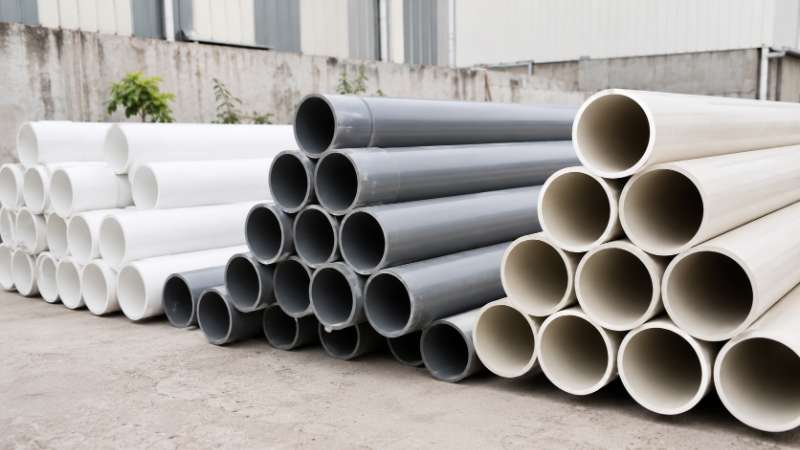
UPVC, MPVC and OPVC are the three grades of PVC pressure pipe most commonly specified on Australian water projects, and the differences between them come down to how each one is manufactured, not the raw material itself. UPVC (unplasticised PVC) is the standard, most economical grade. MPVC (modified PVC) adds an impact modifier for greater toughness at the same wall thickness. OPVC (oriented PVC) uses a molecular orientation process that significantly increases hoop strength, allowing a thinner, lighter pipe at the same pressure class. Getting this choice right at the specification stage affects everything downstream — pressure rating, jointing method, fitting compatibility and installed cost.
This guide breaks down what separates the three types, where each performs best, and what to check before locking in a spec. Viadux supplies the full range of PVC pipe — pressure fittings, OPVC, MPVC and UPVC — for civil, industrial and irrigation projects across Australia.
What Makes Each PVC Type Different?
All three pipe types start from the same PVC resin. What changes is the compound and the manufacturing process applied to it, and that's what drives the difference in strength, wall thickness and application.
PVC-U Pipe (UPVC): Standard Unplasticised Formulation
UPVC — unplasticised polyvinyl chloride — is manufactured to AS/NZS 1477 and is the baseline PVC pressure pipe grade used across Australia for drinking water, recycled water and pressure sewer applications. It's lead-free, corrosion and chemical resistant, and rated for continuous use between 0°C and +60°C. Viadux's UPVC pipe range is available in both solvent weld joint (SWJ) and rubber ring joint (RRJ) formats, with the UPVC S1 Pressure Pipe covering 15–150mm in SWJ and 80–375mm in RRJ, certified to Watermark Level 1 and AS/NZS 4020 for contact with drinking water.
MPVC: Modified PVC for Improved Impact and Pressure
MPVC — modified PVC — is manufactured to AS/NZS 4765. An impact modifier is blended into the compound before extrusion, which raises fracture toughness and resistance to surge and water hammer compared with standard UPVC at the same wall thickness. This makes MPVC the preferred grade on many watermain and pressure sewer projects where surge loading is a design consideration. Viadux's MPVC pipe range is colour-coded for quick identification on site — blue for MPVC S2 (DN100–DN450, RRJ, compatible with ductile iron fittings) and lilac or cream for MPVC S1 (DN100–DN375, SWJ or RRJ).
OPVC: Orientation Process and Wall-Thickness Advantage
OPVC — oriented PVC — is manufactured to AS/NZS 4441. Rather than changing the compound, the pipe is extruded and then biaxially oriented under controlled heat and pressure, realigning the polymer chains around the pipe's circumference. This orientation step is what gives OPVC its higher hoop strength, letting Viadux produce a thinner-walled, lighter pipe for the same pressure class as UPVC or MPVC, with a smooth bore that supports higher flow. OPVC pipe from Viadux is supplied as Series 2 (blue), RRJ, DN100–DN375, and compatible with ductile iron fittings — see the OPVC Pressure Pipe product page for full specifications.
Manufacturing & Material Differences
How UPVC, MPVC and OPVC Are Produced
All three pipe types are extruded from PVC resin, but the process diverges after that point:
-
UPVC is extruded directly from an unplasticised compound with no orientation step — the simplest and most economical process of the three.
-
MPVC blends impact modifiers into the compound ahead of extrusion, increasing toughness without changing the extrusion process itself.
-
OPVC takes an extruded UPVC-grade tube and biaxially orients it under heat and pressure, mechanically realigning the polymer chains before the pipe is cooled and sized.
Additive and Compound Differences
-
UPVC uses a lead-free, unplasticised compound with minimal additives beyond stabilisers.
-
MPVC's impact modifier package is the key compound difference, and it's what drives its higher toughness and surge resistance.
-
OPVC uses essentially the same base compound as UPVC — its strength advantage comes entirely from the orientation process, not a different additive package.
Pressure Ratings Compared
MPVC Pressure Ratings and Design Working Pressure
MPVC's impact modifier allows a higher long-term design stress than standard UPVC at an equivalent wall thickness, which is why it's specified across drinking water, recycled water, watermain and pressure sewer applications where surge protection matters. Full dimension and pressure class tables for each MPVC series sit on the MPVC S1 and MPVC S2 product pages.
OPVC: Same OD, Higher Pressure Class
Because the orientation process increases hoop strength, OPVC can be manufactured to a higher pressure class than UPVC at the same outside diameter and wall thickness — or to match a required pressure class with a thinner, lighter pipe. This is one of the reasons OPVC has gained ground on watermain and pressure sewer projects where handling weight and installed cost are factors. Detailed sizing and class information is available on the OPVC Pressure Pipe page.
UPVC Standard Class Table
UPVC remains the reference grade that MPVC and OPVC pressure classes are typically compared against. Exact PN class and dimension tables for each series vary by size and jointing method, and Viadux publishes these on the individual product pages — UPVC S1 Pressure Pipe, MPVC S1, MPVC S2 and OPVC Pressure Pipe — or in the full Product Range Guide. Always confirm the exact PN class against project head and surge requirements before finalising a spec.
Applications by PVC Type
PVC Pipe Irrigation: Which Type to Use
For irrigation networks, the choice usually comes down to pressure demand and pipe run length. Standard UPVC pipe is a cost-effective choice for shorter, lower-pressure irrigation runs, while MPVC's added toughness makes it a better fit for trunk irrigation mains carrying higher flow and subject to surge from pump start/stop cycles. Viadux supplies PVC pipe for civil, industrial and irrigation projects nationally through its full product range.
Water Mains: MPVC and OPVC Preferred
On watermain projects, MPVC and OPVC are generally preferred over standard UPVC because of their higher pressure class and surge tolerance at a given wall thickness. Both are supplied as RRJ pipe compatible with ductile iron fittings, simplifying transitions between pipe materials on mixed-material networks. See the MPVC pipe and OPVC pipe ranges for size availability.
Drainage: PVC-U Pipe and DWV
For gravity drainage, waste and vent applications — as opposed to pressure reticulation — Viadux supplies a separate non-pressure PVC pipe (DWV) range. These UPVC DWV rubber ring joint pipes are chemical resistant, non-conductive and lead-free, and can be installed above or below ground.
PVC-U Pipe vs PVC DWV: When Each Applies
It's worth being clear on the distinction: UPVC S1 Pressure Pipe is designed for pressurised water reticulation and is rated to a specific PN class, while PVC DWV pipe is a non-pressure product designed for gravity drainage only. The two should never be substituted for each other — specifying non-pressure DWV pipe on a pressure application (or vice versa) is a compliance and safety issue, not just a performance one.
Cost & Availability Comparison
Price Differential Between Types
As a general rule, standard UPVC is the most economical of the three grades, MPVC carries a moderate premium for its impact and surge performance, and OPVC's thinner wall can offset its more involved manufacturing process, often landing it close to — or better than — MPVC on a delivered cost-per-metre basis depending on size and class. Because pricing moves with resin cost and project volume, engineers should confirm current pricing with their nearest Viadux branch rather than relying on historical figures.
Lead Times from Australian Suppliers
Viadux stocks UPVC, MPVC and OPVC pipe across its national branch network, which keeps lead times short for standard sizes and classes. Use the Viadux locations page to find your nearest branch and confirm current stock and lead times before finalising a project schedule.
AS/NZS 1477 Compliance by Type
Each PVC pressure pipe grade is governed by its own Australian Standard: UPVC to AS/NZS 1477, MPVC to AS/NZS 4765, and OPVC to AS/NZS 4441. All three are additionally tested to AS/NZS 4020 for contact with drinking water and, in Viadux's range, are Watermark Level 1 certified. Compliance documentation and certifications are available through Viadux's policies and documents page — worth checking against project specifications before submission, since the standard referenced in a spec often dictates which of the three grades is actually compliant.
Specifier Checklist
Questions to Ask Before Specifying
Before locking in a PVC pipe type, work through:
-
What pressure class (PN) does the project require, including surge allowance?
-
Is the application pressure reticulation, or non-pressure gravity drainage (DWV)?
-
What jointing method does the project standard require — solvent weld (SWJ) or rubber ring joint (RRJ)?
-
Will the pipe need to connect to ductile iron fittings, and does the selected grade support that?
-
Is the water drinking water, recycled water or pressure sewer — and does the product hold the relevant Watermark/AS4020 certification?
-
What size range is needed, and does it fall within the DN range each grade is manufactured to?
-
What are current lead times and pricing from the nearest branch?
Working through this list against the UPVC, MPVC and OPVC product pages will usually settle the choice before a single quote is requested.
Viadux UPVC / MPVC / OPVC Range
Viadux supplies the full spread of PVC pressure pipe — UPVC, MPVC and OPVC — alongside PVC pressure and non-pressure fittings, from a national branch network built to support civil, industrial and irrigation projects. Browse the complete PVC Products range, download the Product Range Guide for full technical specifications, or find your nearest branch to confirm pricing, stock and lead times for your next project.