
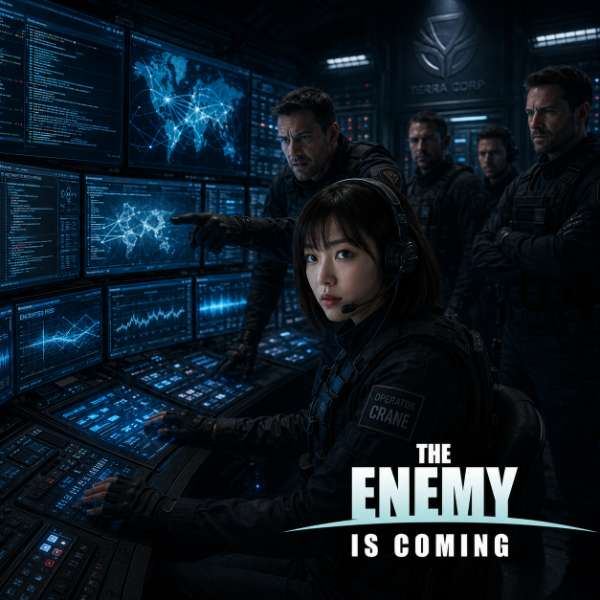
TL;DR: Susan Crane is the communications operator of Terra Corp's field unit in The Enemy Is Coming, a brilliant analyst who is more at home behind a console than on the front line. On her first deployment, she manages the transmitter, decodes incoming signals, and reads the data streams that keep her squad alive, using that focus to hold off the panic of being stranded on an unknown world. She is brilliant, analytical, determined, and quietly vulnerable — the operation's eyes and ears when everything else goes dark.
Susan Crane is the operator who keeps Terra Corp's field team alive by staying locked onto her console instead of the battlefield around her. She is a soldier by training, but a signals specialist by instinct, and that difference defines everything about how she operates under pressure. Her story is part of the wider The Enemy Is Coming universe.
Who is Susan Crane?
She is a radio operator and computer specialist assigned to her first field operation with Terra Corp. Trained as a soldier, but strongest as a technician, she reads data, tracks signals, and keeps communication lines open when nobody else can. On the roster she's Operator Crane — brilliant, analytical, determined, and, underneath the composure, still finding her footing.
What role does Susan Crane play on the team?
She is the voice and the eyes of the operation. Every transmission, every piece of intercepted data, and every status update runs through her station first. See how her role fits alongside the rest of the field team on the characters page. Her job includes:
- Keeping the transmitter online in hostile conditions
- Decoding unfamiliar or corrupted signals
- Analysing incoming data for threats or opportunities
- Relaying real-time intelligence to the rest of the squad
Without her, the team is cut off. With her, they have eyes on the surrounding area before they can even see it themselves.
Why is this her hardest mission yet?
This is her first field deployment, and it's overwhelming in a way her training never fully prepared her for. She's no longer running simulations behind a safe wall of monitors — she's on an alien world, far from home, with the transmitter as her only real anchor to anything familiar.
That gap between training and reality shows up in small ways: the extra second she takes before responding, the way her hands move faster than her breathing does. It's not incompetence. It's a brilliant operator meeting a threat that isn't just technical anymore.
How does she cope with fear in the field?
She copes by working. Staying locked into technical problems is her way of managing anxiety she doesn't have time to feel. Every signal decoded and every data point reviewed is one more thing keeping her mind off the terrifying truth of where she actually is.
This coping pattern is consistent and deliberate:
- When fear rises, she narrows her focus to the next task
- When the task is solved, she immediately moves to the next one
- When there's nothing technical left to do, the fear catches up
That third stage is where her character becomes most interesting — the moment the console goes quiet and she has to sit with the reality around her.
How is Susan Crane portrayed in the movie?
Susan is portrayed as someone defined less by what she says and more by what she does with her hands when she's afraid. On screen, her emotional state comes through in her technical output — how clean her decoding is, how fast she responds, how often she double-checks work she'd normally trust on the first pass.
This portrayal keeps her active even in scenes with no combat role. She doesn't need a weapon to hold the tension; she needs a signal to chase.
The performance also sets up her turning point: the scene where focus alone isn't enough, and Susan has to face the mission — and her fear — directly rather than through a screen.
FAQ
Q: Who is Susan Crane?
A: She is the radio operator and computer specialist for Terra Corp's field unit in The Enemy Is Coming. A trained soldier, she's most effective managing communications, decoding signals, and analysing incoming data rather than fighting on the front line.
Q: What is her role in the story?
A: She's the team's communications hub — the operator who keeps the transmitter running, reads every incoming signal, and feeds real-time intelligence to the rest of the squad during their first deployment to an alien world.
Q: Why is she anxious during the mission?
A: This is her first field operation, and the unfamiliar, hostile environment is far outside her training. Her anxiety is real, but she channels it into hyper-focused technical work rather than letting it take over.
Q: How does she manage her fear?
A: She pours her attention into solvable problems — keeping the transmitter online, decoding signals, analysing data — because staying technically engaged keeps her mind off how exposed and far from safety she really is.
Q: Is she a soldier or a technician?
A: Both, but she's most comfortable as a technician. She has combat training as a soldier, but her identity and confidence come from her skill with communications and data, not from combat.
She is a character defined by the tension between two roles: trained soldier and instinctive technician, with the console always winning out as her true comfort zone. Her value to the team is her ability to keep signals, data, and communication flowing even as her own composure is tested for the first time in the field. Susan is portrayed not through what she says under pressure, but through what she does with her hands — the transmitter she keeps online, the signal she refuses to lose. To follow Susan Crane's story as it unfolds, subscribe for updates.