
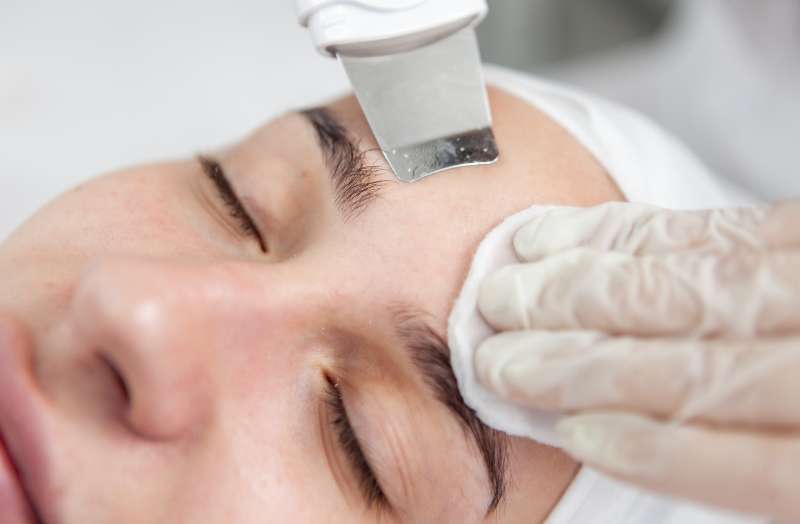
There's a pattern we see consistently in the treatment room at Pur Artistry in LoHi. A client comes in for a K-beauty facial. The session goes well, the skin analysis shows what we need to address, the treatment is calibrated to their specific barrier condition, they leave with skin that looks and feels genuinely different. Then they come back four weeks later and what we built is mostly gone. Not because the treatment didn't work. Because something undid it.
Almost always, that something is UV exposure.
Denver's altitude creates a UV environment that's significantly more demanding than most skincare routines, including sophisticated K-beauty routines are built to account for. At higher altitudes, there is simply less air mass filtering out UV radiation before it reaches you. UV intensity increases by roughly 4 to 5 percent for every 1,000 feet of elevation gained which means at 5,280 feet, Denver residents are absorbing approximately 25% more UV radiation than someone doing the same outdoor activity at sea level.
Colorado gets more than 300 days of sunshine per year - year-round exposure, including in winter when snow reflects UV rays back upward and catches skin from angles people rarely think about.
That UV load isn't abstract. It's actively working against every result your K-beauty facial just produced. Here's exactly how.
Read Also: Why Your Skin Keeps Breaking Out Even When You’re Doing Everything Right
What a K-Beauty Facial Actually Builds
To understand what UV degrades, it helps to be specific about what the treatment creates.
A K-beauty facial at Pur Artistry isn't a surface-level polish. It's a structured protocol that rebuilds and supports specific skin architecture:
Ceramide levels. Ceramides are the lipid molecules that make up the "mortar" holding skin cells together in the stratum corneum. They're responsible for the barrier's ability to retain moisture and exclude irritants. After a K-beauty facial particularly the Pur Zen Facial, we've applied ceramide-rich formulations that help rebuild whatever depletion has occurred from Denver's dry air, daily cleansing, and environmental stress.
Hyaluronic acid saturation. The hydration achieved during a K-beauty facial isn't just surface moisture. Applied correctly to damp skin, layered in sequence, sealed with the right occlusive, hyaluronic acid draws and holds water through multiple skin layers. That's what creates the plump, supple texture immediately post-facial.
Cell renewal momentum. The K-Glow Facial uses gentle exfoliation and circulation-stimulating massage to support cell turnover and bring fresh, functioning cells to the surface. This is what creates visible radiance not product shimmer, but actual skin cells doing their job.
Barrier integrity. Everything above depends on the skin's barrier staying intact enough to hold what we've put in place. The barrier is the structure that determines whether the results of a professional treatment last a week or a month.
UV exposure targets all four simultaneously.
What Denver's UV Does to Each of Them?
UV degrades ceramides directly.
Lipidomic analysis of UV-exposed skin showed shifts in the composition of ceramide subclasses essential in repairing and strengthening the stratum corneum barrier. The specific ceramide types altered are the ones responsible for barrier cohesion and moisture retention, the same ones we've worked to restore. UV exposure reduces cellular cohesion, largely dominated by the intercellular lipids, including the lamellar sheets of ceramides, cholesterol, and fatty acids that form the barrier's structure.
In plain terms: the ceramide layer we rebuilt in your last facial is weakened by the UV your skin absorbs on the walk to your car.
UV accelerates hyaluronic acid breakdown.
Continuous UVB exposure increases transepidermal water loss and decreases skin hydration, which impairs skin barrier function. UV radiation activates hyaluronidase, the enzyme that degrades hyaluronic acid, while simultaneously suppressing hyaluronic acid synthase, the enzyme that produces it.
The hyaluronic acid saturation achieved during your facial has a shorter half-life in Denver than it would in Seattle, Miami, or anywhere with less UV intensity. Without SPF intercepting that UV before it reaches the skin, the hydration advantage of a professional treatment compresses.
Read Also: Your Skin Is Communicating. Here’s How to Read It.
UV stops collagen synthesis, sometimes for days.
The pathways that promote normal collagen synthesis are effectively stopped 24 hours after exposure to UV radiation. UV radiation also induces the production of matrix metalloproteinases enzymes that actively degrade collagen.
This is why the skin can look visibly different after a few unprotected days in Denver's sun even when a professional treatment was recent. The treatment stimulates renewal. UV pauses it and starts undoing the structure simultaneously.
UV compounds barrier breakdown already stressed by altitude.
Denver's combination of high altitude, low humidity averaging 30–35%, and 20% more intense UV radiation than sea level creates chronically accelerated transepidermal water loss, moisture evaporating out of your skin faster than your routine can replace it.
The barrier we repaired in a single session is being pressured from two directions at once: dry air pulling moisture out, UV degrading the lipid architecture holding it in. Without SPF, that repair has a very short window before it needs to happen again.
How K-Beauty Actually Thinks About SPF
This is where the cultural context matters.
In Korean beauty culture, sunscreen is considered the most important step in any skincare routine, not an afterthought. This cultural emphasis has driven brands to create formulas that function as both skincare and a makeup base.
K-beauty doesn't treat SPF as sun safety compliance. It treats SPF as the step that protects every other step. The essence, the serums, the ceramide-rich moisturizer, the professional facial, all of it is an investment. SPF is what makes that investment compound instead of decay.
This is especially pointed in Denver. The altitude creates UV conditions that make SPF not just philosophically important but mechanically necessary for professional treatment results to last. Without it, we're rebuilding in the session what unprotected UV exposure dismantles between sessions. That's not a sustainable cycle and it's not what a K-beauty practice is designed to be.
What We Actually Recommend at Pur Artistry?
We're not a product retail counter and we don't recommend specific brands in sessions. But we do have this conversation with every client, because it's part of what makes the treatment last.
Minimum SPF 30, broad-spectrum, daily. Not on sunny days. Not just in summer. Denver sits at 5,280 feet of elevation. UVA rays are present year-round and pass through clouds and windows contributing to barrier damage, collagen degradation, and photoaging even on overcast days.
Mineral filters over chemicals for post-facial skin. Immediately after a K-beauty facial, the skin is sensitized from the treatment process. Mineral SPF (zinc oxide, titanium dioxide) sits on top of the skin and reflects UV rather than absorbing it through chemical conversion, which means less interaction with a freshly-treated, sensitized barrier.
Apply it last, give it time to bind. SPF goes on after moisturizer, and ideally 10–15 minutes before UV exposure. Applied immediately before going outside reduces its effective protection. In Denver, where you can walk from an interior to intense UV exposure instantly, this timing matters more than it does elsewhere.
Don't skip reapplication. A single morning application provides protection for roughly two hours of sun exposure. For anyone spending time outdoors which in LoHi means walking the neighborhood, sitting at a coffee shop, attending outdoor events, reapplication is the step that turns SPF from a morning ritual into actual protection.
Read Also: 5 Things Your Home Routine Is Doing to Your Skin and How a K-Beauty Facial Reverses Them
The Practical Implication for Your Facial Schedule
We recommend K-beauty facials every four to six weeks aligned with the skin's natural 28-day cell turnover cycle. With consistent SPF use, that timing works. The treatment results hold through most of the cycle, and each session builds on a foundation that hasn't been significantly degraded.
Without SPF, the effective window of a K-beauty facial is shorter. The ceramides we rebuilt start degrading faster. The hyaluronic acid saturation compresses. The barrier that was repaired comes under immediate environmental pressure. What should be a monthly investment starts feeling like diminishing returns, because it is.
The treatment and the sun protection aren't separate parts of a skincare approach. In Denver's UV environment, they're two components of the same system. One builds. The other protects what was built.
That's the K-beauty understanding of SPF and it's why we talk about it in every session at Pur Artistry.
Book Your K-Beauty Facial at Pur Artistry LoHi → When you book, let us know what SPF you're currently using, we'll help you understand where it fits in your sequence and whether it's suited for post-facial skin.
FAQs
Q: How soon after a K-beauty facial should I start wearing SPF again?
The morning after your facial. We recommend skipping SPF on the day of treatment to avoid any potential interaction with freshly-treated, sensitized skin. From the following morning, daily SPF resumes as normal and is especially important in the first week post-facial when the renewed skin cells are most vulnerable to UV stress.
Q: Does SPF actually affect how long my K-beauty facial results last?
Directly, yes. UV exposure degrades ceramides, accelerates hyaluronic acid breakdown, and inhibits collagen synthesis all of which are the specific outcomes a K-beauty facial is designed to support. In Denver's altitude, where UV intensity is roughly 25% stronger than at sea level, the degradation rate without SPF is meaningfully faster than in other cities. SPF is the variable that determines whether your facial results hold for a few days or a few weeks.
Q: What SPF is recommended after a K-beauty facial?
Broad-spectrum SPF 30 minimum, with a mineral formula (zinc oxide or titanium dioxide) preferred for post-facial use. Mineral filters sit on the skin's surface rather than penetrating it, which reduces irritation risk on sensitized post-treatment skin. For Denver's UV conditions, SPF 50 is a practical choice for anyone spending time outdoors.
Q: Does SPF interfere with K-beauty layering?
It can, if applied incorrectly. SPF goes on last in the morning sequence after toner, essence, serum, and moisturizer. Applying it before other products reduces its effectiveness. Common issues: pilling (usually from applying SPF over a layer that hasn't fully absorbed) and white cast (usually mineral formulas on certain skin tones, solvable with tinted options). If you're having layering issues, that's a conversation worth having at your next session.
Q: Can I use a moisturizer with SPF instead of a separate sunscreen?
As a minimum, yes. As optimal protection, no. Moisturizer-SPF hybrids are typically applied at a thickness that provides less UV protection than the labeled SPF because SPF is tested at a specific application weight that most people don't use with a moisturizer. A dedicated SPF product, applied after moisturizer, delivers more consistent protection. In Denver's UV environment specifically, the difference between adequate and optimal protection compounds over time.