
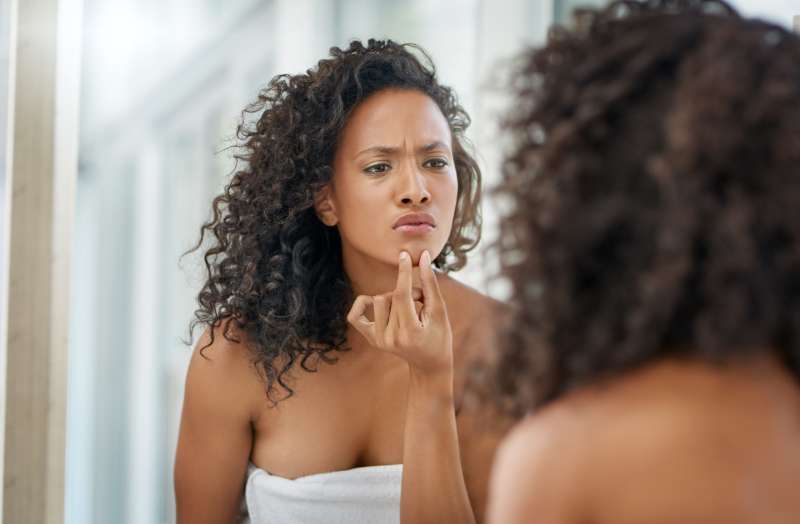
You've cleaned up your routine. You switched to a gentle cleanser. You're consistent. You drink water. You're not skipping SPF as often as you used to. And you're still breaking out.
This isn't a willpower problem. It's a misdiagnosis problem. And if you work in the Denver Tech Center area, there's a specific combination of factors: altitude, dry air, cortisol from high-demand work weeks, and the instinct to treat breakouts with more purifying steps that makes this pattern harder to break than it would be almost anywhere else.
At Pur Artistry in DTC, we see this in the treatment room regularly. Professionals who've invested real effort into their skincare routines, still dealing with breakouts they can't explain. The issue almost never is what they think it is.
Here's what's actually happening and what a K-beauty facial does to break the cycle.
The Diagnosis Most People Get Wrong: Dehydrated Acne vs. Oily Acne
This distinction is the foundation of everything. Most people assume breakouts mean oily skin. If your skin feels oily but also tight or flaky, you're likely experiencing dehydrated acne-prone skin. Unlike dry skin, which lacks oil, dehydrated skin lacks water. You can have oily skin, combination skin, or acne-prone skin and still be dehydrated.
When most people see a breakout, they reach for a clarifying cleanser, increase exfoliation, and cut back on moisturizer. For oily acne, that's partially reasonable. For dehydrated acne, those habits backfire. Skipping moisturizer because you fear it will cause breakouts actually triggers more oil production. Using acne treatments formulated for oily skin on already dehydrated skin creates excessive dryness, irritation, and paradoxical breakouts.
The result: you treat what looks like an oil problem, make the dehydration worse, and the breakouts continue or intensify.
How to tell the difference: Signs of dehydrated acne include skin that feels tight especially after cleansing, yet you still develop pimples. Fine lines appear more pronounced. The complexion looks dull rather than glowing. Skin texture feels rough or uneven even when you're breaking out.
Oily acne tends to feel consistently greasy, with larger pores and breakouts that respond to salicylic acid. Dehydrated acne doesn't follow that pattern. Products sting. Breakouts are often small, hard bumps beneath the surface. The "oiliness" you notice mid-day is your skin compensating not your natural state.
Read Also: Your Skin Is Communicating. Here’s How to Read It.
Why Denver and the DTC Work Week Make This Worse?
This breakout pattern is common. In Denver's specific conditions, it's almost unavoidable without a deliberate strategy.
The altitude dehydration factor: Denver's combination of high altitude, low humidity averaging 30–35%, and 20% more intense UV radiation than sea level creates chronically accelerated Transepidermal Water Loss moisture evaporating out of your skin faster than your routine can replace it. Even oily skin types can feel like sandpaper in Colorado because your skin's natural barrier simply can't keep up without intentional support.
Most skincare routines are built for climates with 50–75% humidity. At 30%, the same routine doesn't perform the same way. Hyaluronic acid applied to dry skin in Denver doesn't hydrate in low humidity, it pulls moisture upward from deeper layers and allows it to evaporate. The barrier gets more depleted. The skin compensates with more oil. The breakouts continue.
The cortisol factor: Stress triggers cortisol spikes which are directly linked to increased breakouts. Stressful lifestyles and demanding work environments cause cortisol to spike, increasing oil production and slowing down healing.
When stress hits, the skin's oil glands respond directly to the brain's stress signal producing more oil and triggering local inflammation independently. This is why stress breakouts can appear at any time of month and across all skin types, not just in those prone to hormonal acne.
For DTC professionals, this isn't a background factor, it's a consistent one. Chronically elevated cortisol raises circulating inflammatory cytokines, which means your skin is operating at a higher baseline level of inflammation before a single pore clogs. When bacteria get into a clogged follicle, the inflammatory response is more severe.
The DTC breakout pattern is usually dehydration plus cortisol plus the wrong treatment approach stacked together. Treating any one of these in isolation doesn't resolve it.
What to Stop Doing (That Feels Like the Right Move)?
Most DTC professionals dealing with this pattern are doing several things that make clinical sense but actively worsen the cycle:
Cleansing more frequently. The oiliness you feel mid-day is often your skin's response to previous over-cleansing. Cleanse twice daily morning and evening and resist the urge to wash more even when you feel oily. Every additional cleanse strips what the barrier is trying to rebuild.
Adding more acne-targeting actives. Salicylic acid, benzoyl peroxide, and strong AHAs are appropriate for oily, congested acne. On a dehydrated, barrier-compromised skin, they remove the protective layer the skin is already struggling to maintain. The more you add, the more reactive the skin becomes and the more it overproduces oil to compensate.
Skipping moisturizer. Dehydrated skin can produce even more oil, leading to more breakouts. Even acne-prone skin needs hydration choose lightweight, non-comedogenic options rather than eliminating this step entirely.
Treating each breakout individually. Spot treatments address a single pimple. They don't address the barrier condition that's producing the environment for breakouts. Without resolving the root cause, new ones form in the same cycle.
Read Also: 5 Things Your Home Routine Is Doing to Your Skin and How a K-Beauty Facial Reverses Them
What to Start Doing Instead?
The shift is counterintuitive from conventional acne wisdom, but it follows directly from the diagnosis:
1. Hydrate first, clarify second. Barrier repair has to precede acne treatment. Ceramides, hyaluronic acid on damp skin, and panthenol rebuild the moisture architecture the skin needs to regulate sebum on its own. Once the barrier is functional, oil production often normalizes without additional acne-targeting steps.
2. Simplify the active stack. One active ingredient at a time, used infrequently enough for the barrier to recover between applications. For dehydrated acne specifically, niacinamide is often a better first move than any exfoliating acid, it regulates sebum and supports the barrier simultaneously without adding removal load.
3. Give the skin a professional reset. Home care operates within whatever state your barrier is already in. If that state is compromised, the products you apply, however good, are working at reduced effectiveness. A professional treatment clears and resets the foundation so that everything you do at home afterward can actually function as intended.
How a K-Beauty Facial Breaks the Dehydration-Breakout Loop?
The K-beauty framework is specifically suited to this breakout pattern because it starts with diagnosis, not treatment assumptions.
At Pur Artistry, we begin every session with a skin analysis. For the dehydration-breakout pattern, what we typically see: a compromised barrier, surface congestion from sebum overproduction, and a skin that's reactive to almost everything because the protective layer has been stripped by the routine designed to help it.
Our response isn't to add more acne-targeting steps. It's to work with the biology:
For active dehydrated acne: We use the Pur Zen Facial, no exfoliation, no actives, pure barrier repair. Centella asiatica to calm the inflammation that cortisol has elevated. Ceramides to rebuild what altitude and the routine have stripped. A long-dwell hydrating mask that lets the skin absorb without being pushed to tolerate anything additional. The goal of this session is creating the conditions where the skin can start regulating itself.
For acne-prone skin that's ready for treatment: We use the K-Glow Facial gentle enzyme exfoliation calibrated to what the barrier can handle, followed by niacinamide and targeted serums that address congestion and sebum regulation without compromising hydration. LED light therapy at the end reduces the bacterial load and inflammation that contributes to breakouts without touching the barrier.
In both cases, we also have the conversation about what the home routine is doing, specifically what's working against the skin rather than for it. Most clients leave with a significantly simpler protocol than they arrived with. That simplification is usually what allows the skin to finally stop breaking out.
Read Also: Beyond Skin Deep: The Rise of Ritual-Based Facials at Denver’s Luxury K-Beauty Spa
The Breakouts Aren't Random. Neither Is the Solution.
If you've been dealing with persistent breakouts on what looks like a clean, intentional routine, the most important thing to understand is this: the routine itself is likely part of the problem, not because of bad choices, but because those choices were calibrated for a different skin state or a different climate.
Denver's altitude, DTC's cortisol load, and the instinct to treat breakouts with more purifying steps create a specific loop. A K-beauty facial at Pur Artistry doesn't just treat the current breakouts. It resets the conditions that are generating them.
Book Your K-Beauty Facial at Pur Artistry. Tell us what your current breakout pattern looks like when you book, it helps us determine which facial is the right starting point before you arrive.
FAQs
Q: Can dehydration actually cause breakouts?Yes and it's one of the most consistently misread breakout patterns. When skin lacks water, it signals the sebaceous glands to produce more oil to compensate. That excess oil mixes with dead skin cells, clogs pores, and creates breakouts that look like an oiliness problem but are actually a dehydration response. In Denver's low-humidity, high-altitude environment, this cycle develops faster than in most other cities because the air is actively pulling moisture from the skin around the clock.
Q: How is dehydrated acne different from regular acne? Oily acne presents with consistently greasy skin, enlarged pores, and breakouts that respond to salicylic acid and oil-controlling treatments. Dehydrated acne presents with skin that feels tight or dull despite breaking out, small hard bumps beneath the surface rather than large inflamed pustules, and products that sting or burn on application. The critical difference: oily acne benefits from clarifying treatments. Dehydrated acne is worsened by them.
Q: Why do I break out more during stressful work weeks? Cortisol, the primary stress hormone, directly signals the skin's oil glands to produce more sebum, independently of your skincare routine or your cycle. It also raises baseline skin inflammation, meaning that when a pore does clog, the inflammatory response is more severe than it would be in a lower-cortisol state. For DTC professionals in high-demand environments, chronically elevated cortisol is a consistent factor in persistent breakouts that don't respond to routine changes alone.
Q: Should I stop using all my activities if I'm breaking out from dehydration? Temporarily simplifying the active stack is usually the right move, yes. The barrier needs to recover before it can tolerate exfoliating acids, strong retinoids, or layered treatments effectively. We typically recommend stripping back to a gentle cleanser, barrier-repair moisturizer, and SPF for two to four weeks while getting professional treatment to reset the baseline. Once the barrier is stabilized, we reintroduce actives one at a time with more spacing.
Q: Which Pur Artistry facial is better for breakouts the Pur Zen or K-Glow? It depends on what we see in the skin analysis. If the barrier is actively compromised, reactive, stinging, or inflamed the Pur Zen Facial is the right starting point: barrier repair without exfoliation or additional actives. If the skin is more stable but dealing with congestion and sebum regulation, the K-Glow Facial introduces gentle exfoliation, targeted serums, and LED light therapy in a calibrated sequence. We make this determination after looking at the skin, not before. Both are appropriate for acne-prone skin; the choice depends on the current state of the barrier.